
8 Auto Repair Shop Marketing Strategies to Get More Customers in 2026
Learn how auto repair shops can get more calls, build stronger Google reviews, improve local SEO, and bring more customers back with a repeatable marketing system.

William Peterson
Growth Marketing @ ReviewCatch
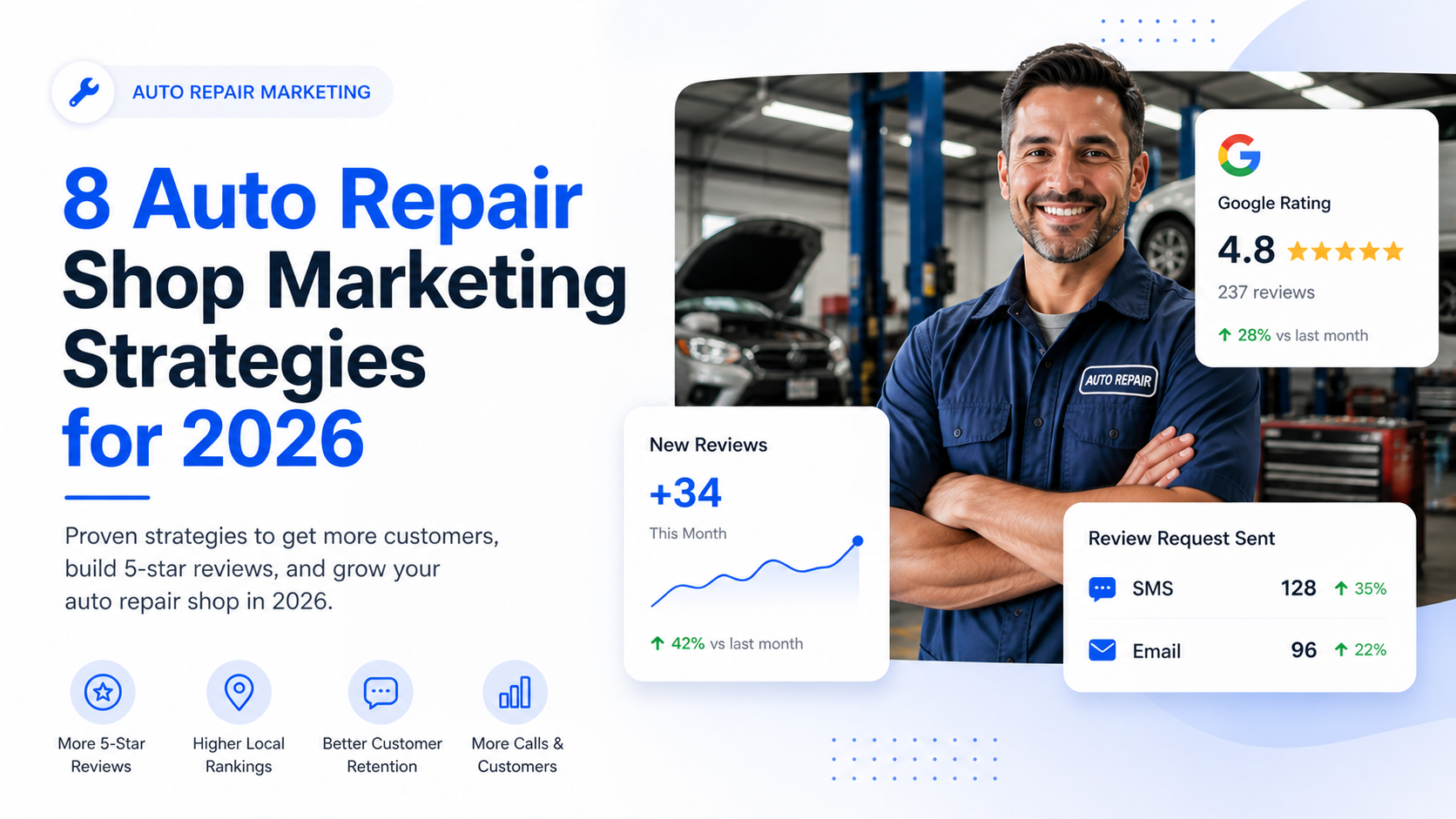
Most auto repair shop owners already know how to solve hard vehicle problems.
A misfire that only shows up hot. A brake vibration another shop missed. An electrical issue that eats half a day. A customer who says, “I need it back by 5.”
The work is demanding, but at least the problem is visible.
Marketing is different. It gets pushed aside because it feels less urgent than the cars in the bays. That is how many shops end up in the same cycle: busy weeks, slow weeks, occasional discounts, random social posts, and a heavy reliance on word of mouth.
That can work for a while. Then a competitor with stronger Google reviews, better follow-up, and a more active local presence starts getting the calls that should have gone to you.
Auto repair marketing works best when it is treated like an operating system, not a pile of random tactics.
Reviews feed local SEO. Local SEO improves map visibility. SMS and email bring customers back. Review responses build trust. Social proof makes ads, service pages, and social content more believable.
The shops that win in 2026 will not be the ones posting the most or discounting the hardest. They will be the shops that build a repeatable marketing system around trust, timing, and follow-up.
This guide breaks down eight auto repair shop marketing strategies that work together, where shops usually waste money, and how to build a system that helps keep service bays full without depending only on referrals.
1. Build a Google Review Engine
A driver searches “brake repair near me” after work, compares three shops on Google Maps, reads a few reviews, and calls one.
That decision often happens before your website gets a serious look.
If your review profile looks thin, outdated, or inconsistent, even a great shop can lose the call to a competitor with stronger public proof.
Google reviews are not just nice to have. They influence trust, local visibility, and conversion. BrightLocal’s 2026 Local Consumer Review Survey found that 97% of consumers read reviews for local businesses, 74% look for reviews written in the last three months, and 85% are more likely to use a business after reading positive reviews.
For auto repair shops, this matters because customers are often making a high-trust decision. They are handing over an expensive asset and hoping the shop is honest, competent, and fair.
Why review consistency matters
Most shops do not have a review problem because customers are unhappy. They have a review problem because nobody built the ask into the workflow.
The service advisor is busy. The customer is trying to get back to work. The car is ready. The phone is ringing. Asking for a review depends on whoever remembers.
That is not a system.
A working review engine usually has a simple rhythm:
- The repair order closes.
- The customer receives a short SMS or email.
- The message includes a direct Google review link.
- One polite reminder is sent if there is no response.
- Repeat customers are protected by cooldown rules.
The goal is not to pressure customers. The goal is to make it easy for real customers to leave honest feedback while the visit is still fresh.
What a good review request looks like
Keep it short and specific.
SMS example:
Hi [First Name], thanks for choosing [Shop Name] for your [service]. If you have a minute, could you leave us a quick Google review? It helps other local drivers find us. [Review Link]
That message works because it is simple, timely, and tied to the actual service.
“Thanks for trusting us with your brake inspection today” usually beats “Please review our business.” Specificity makes the request feel real.
2. Optimize Your Google Business Profile and Local SEO
Your Google Business Profile is one of the most important marketing assets your shop has.
For many customers, it is your first impression. It shows your reviews, rating, hours, services, photos, location, phone number, website link, and directions.
A weak profile drags down the return on everything around it. You can spend money on ads, post on social media, or send direct mail, but if prospects click through and see outdated hours, few recent reviews, or poor photos, conversion drops.
Start with the basics
Before spending more on marketing, tighten your profile:
- Confirm your name, address, phone number, website, and hours.
- Choose accurate primary and secondary categories.
- List your core services clearly.
- Add real photos of the shop, team, waiting area, bays, equipment, and exterior.
- Answer common Q&A questions.
- Make sure the phone number and booking link work on mobile.
- Use the correct Google review link in all review requests.
Your profile should make a customer feel like they found a real, active, professional shop.
Think like a local customer
A customer searching “check engine light diagnosis near me” is not casually browsing. They usually want a nearby shop, signs of trust, and a clear next step.
That is why local SEO should start with the map pack, not broad awareness campaigns.
A good Google Business Profile helps customers answer three questions quickly:
- Is this shop close enough?
- Does this shop look trustworthy?
- Can I call or book easily?
If the answer to any of those is unclear, the customer moves on.
3. Use SMS for Service Updates, Review Requests, and Follow-Up
SMS is powerful for auto repair because customers are often waiting on an update.
They want to know if the car is ready. They want to approve an estimate. They want to know when to pick up the vehicle. They may miss a phone call during work, but they will often see a text.
That makes SMS one of the most practical marketing and operations channels for auto repair shops.
Where SMS works best
Texting should be tied to useful moments, not random promotions.
Use SMS for:
- Appointment reminders
- Drop-off instructions
- Estimate approval links
- Pickup notifications
- Payment links
- Post-service review requests
- Declined work follow-up
- Seasonal maintenance reminders
The key is context. A pickup text after the repair is useful. A random discount blast every week is noise.
Do not abuse the channel
SMS gets attention quickly, but it also burns trust quickly if you overuse it.
Keep texts short. Make them relevant. Give customers a clear reason to act. Avoid turning every message into a coupon.
A smart SMS workflow should be connected to your shop management system, CRM, or review automation tool. That prevents awkward timing, like sending a review request before pickup or sending a promo text right after a poor experience.
4. Use Email to Bring Customers Back
A customer leaves after an oil change, says they will be back for brakes in a month, then disappears for nine months.
That usually is not a demand problem. It is a follow-up problem.
Email works best when it is tied to service history. Shops already paid to earn the customer once. Retention campaigns help get more value from that customer relationship without cutting price every month.
Stop sending generic blasts
Generic emails are easy to send and easy to ignore.
A customer who declined brake work needs a different message than a customer due for seasonal tire service. A customer with a newer vehicle needs different education than someone driving an older high-mileage car.
Segment your email list by:
- Service history
- Declined work
- Mileage interval
- Vehicle type
- Last visit date
- Seasonal service need
- Customer value
Relevant emails perform better because they match the customer’s actual situation.
Emails worth sending
The best auto repair email campaigns are tied to real operational moments:
- Maintenance reminders: Based on last visit date, mileage, or manufacturer interval.
- Declined work follow-up: Remind customers what was postponed and why it matters.
- Seasonal reminders: Tires, batteries, AC, cooling system, wipers, and winter prep.
- Win-back emails: Bring inactive customers back with convenience and trust, not just discounts.
- Review and testimonial highlights: Show proof from real customers.
- Educational emails: Explain common vehicle issues in plain language.
The goal is not more email. The goal is better-timed email.
5. Turn Reviews Into Social Proof Everywhere
A good review should not sit on Google doing only one job.
It can support your website, service pages, social posts, ads, sales emails, and front-counter conversations.
If a customer says your shop explained the repair clearly, stayed on schedule, and charged fairly, that review is stronger than most ad copy. It says what future customers actually want to know.
Where to reuse reviews
Use reviews in places where customers are deciding whether to trust you:
- Service pages
- Homepage sections
- Booking pages
- Quote request pages
- Google Business Profile posts
- Facebook and Instagram posts
- Email campaigns
- Paid ad creative
- Waiting area screens or printed material
Keep it simple. A short review with a star rating and customer first name can do a lot.
Match the review to the service
A brake repair page should show brake-related reviews. An AC repair page should show AC-related reviews. A diagnostics page should show reviews that mention clear explanations, honesty, or solving a difficult issue.
Specific proof beats generic proof.
6. Respond to Reviews Like Future Customers Are Watching
Getting reviews is only half the job.
What you do after the review is public.
Future customers read your responses to see how the shop handles people. A shop that never replies looks inattentive. A shop that argues looks risky. A shop that responds calmly and professionally looks safer to call.
How to respond to positive reviews
A strong positive review response is short and specific.
Example:
Thanks for the kind words, Sarah. We’re glad the brake repair went smoothly and that the team explained everything clearly. We appreciate you choosing us.
That reply reinforces what the shop wants to be known for: clear communication, professional service, and trust.
How to respond to negative reviews
Do not argue in public.
A better response pattern is:
- Acknowledge the concern.
- Stay calm.
- Avoid defensive language.
- Offer a direct contact path.
- Investigate internally.
- Use repeated complaints as operational feedback.
Example:
We’re sorry to hear the visit did not meet expectations. Please contact our manager at [phone/email] so we can look into what happened and work toward a resolution.
A negative review is not always a marketing problem. Sometimes it is an operations problem showing up in public.
Look for repeated themes like wait times, unclear estimates, pricing confusion, poor communication, or comeback work. Those patterns can guide training and process improvements.
7. Use Video and Educational Content to Build Trust
Video marketing does not have to mean becoming an influencer.
For auto repair shops, video is mostly about making expertise visible.
Customers do not always understand repairs, but they can understand a technician explaining worn brake pads, a failing battery, a leaking hose, or the difference between urgent and optional work.
That kind of content reduces skepticism.
Simple video topics for auto repair shops
You do not need cinematic production. You need clarity.
Useful topics include:
- What a check engine light can mean
- How to know when brakes need attention
- Why a battery fails in cold weather
- What happens during an oil change
- Why tire rotations matter
- How to prepare a car for winter
- What customers should know before approving a repair
- The difference between urgent and deferred work
Keep videos focused. One problem, one explanation, one next step.
Use real shop footage
Authenticity matters more than polish.
Show the bay. Show the part. Show the technician. Use captions because many people watch without sound.
A simple 45-second explanation from a real technician can build more trust than a polished generic ad.
Video also supports your other channels. You can turn one short video into a social post, email tip, website FAQ section, and Google Business Profile update.
8. Build Referral and Loyalty Systems
Referrals still matter. They just work better when they are organized instead of left to chance.
The best referral partners usually serve the same customer before or after the repair need appears. That can include used car dealers, body shops, tire stores, tow companies, detailers, fleet operators, and local businesses with company vehicles.
Make referrals trackable
Referral programs fail when nobody tracks lead quality.
Track:
- Partner source
- Average repair order value
- Approval rate
- Comeback risk
- Customer fit
- Response speed
- Repeat business
Not every referral partner is worth keeping. Some send price shoppers. Others create unrealistic turnaround expectations. The best partners send customers who fit the work your shop actually wants.
Make loyalty about convenience, not just discounts
A loyalty program should do more than make the current invoice cheaper.
Price-based offers can fill a slow week, but they often train customers to wait for coupons. Better loyalty programs protect margin by giving customers a reason to stay connected.
Examples include:
- Priority scheduling
- Seasonal maintenance reminders
- Free courtesy inspections with routine service
- Prepaid maintenance bundles
- Member-only perks
- Vehicle-specific reminders
The goal is retention with control.
A good loyalty program makes the next appointment easier to win. If it only makes the current visit cheaper, it needs to be rebuilt.
Keep Review Requests Google-Compliant
This part matters.
Google allows businesses to ask customers for reviews, but the request needs to be genuine, fair, and non-manipulative.
Shops should avoid:
- Offering discounts, gifts, or rewards in exchange for reviews
- Asking only happy customers to leave public reviews
- Discouraging negative reviews
- Pressuring customers to leave a specific rating
- Asking customers to mention specific keywords or employees
- Posting fake reviews or asking others to do it
- Asking customers to leave reviews from an in-store device that creates suspicious patterns
The clean approach is simple:
- Ask real customers.
- Ask after real service interactions.
- Make the process easy.
- Use the same fair process consistently.
- Do not offer rewards for reviews.
- Do not filter unhappy customers away from Google.
- Respond professionally to both positive and negative feedback.
Cooldown rules also matter for auto repair shops. A customer who comes in often should not receive a review request after every visit. That gets annoying and makes the shop look disorganized.
A better system checks whether the customer was asked recently, whether they already reviewed, and whether enough time has passed to make another request reasonable.
Where ReviewCatch Fits
ReviewCatch helps auto repair shops turn completed jobs into timely review requests, follow-ups, and reputation growth without adding more manual work to the front counter.
Instead of relying on advisors to remember who to ask, ReviewCatch can help connect review requests to real customer events like completed repair orders, paid invoices, appointments, or follow-up workflows.
For auto repair shops, that means:
- SMS and email review requests can go out at the right time.
- Repeat customers can be protected with cooldown rules.
- Review activity can be tracked in one place.
- Strong reviews can support local trust and conversion.
- Shop owners can spend less time chasing follow-up manually.
ReviewCatch does not replace good service. It helps make sure good service turns into visible proof.
That is the real marketing advantage.
Quick-Start Checklist for Auto Repair Shops
Most shops do not need more marketing ideas. They need a clearer order of operations.
Start here:
- Clean up your Google Business Profile. Make sure hours, services, photos, categories, and links are accurate.
- Build a review request workflow. Send requests after completed visits with a direct Google review link.
- Use SMS for timely service communication. Appointment reminders, pickup notices, approvals, and review requests are the best places to start.
- Use email for retention. Focus on maintenance reminders, declined work, seasonal service, and win-back campaigns.
- Respond to reviews consistently. Treat review responses as part of customer service.
- Repurpose strong reviews. Use them on service pages, social media, and emails.
- Create simple educational content. Show real shop expertise with short videos and plain-language posts.
- Track referrals and repeat business. Keep what works and cut what does not.
Do not try to do everything at once.
First, tighten the Google Business Profile and build a repeatable review system. Second, connect SMS and email to actual service events. Third, repurpose reviews, photos, and videos into social proof. Fourth, add referral and loyalty systems once the core workflow is stable.
That order prevents wasted effort.
Final Takeaway
Auto repair shop marketing in 2026 is not about random social posts, constant discounts, or hoping word of mouth keeps the bays full.
It is about building a system.
A strong system helps local drivers find the shop, trust the shop, book the shop, and come back when they need service again.
The foundation is simple: better Google reviews, stronger local visibility, useful SMS and email follow-up, professional review responses, and social proof that keeps working after the customer leaves.
The best shops will not treat those pieces as separate tactics.
They will connect them.
That is how auto repair marketing becomes more predictable, less stressful, and easier to manage when the shop gets busy.
Ready to turn finished jobs into more reviews?
ReviewCatch helps auto repair shops automate review requests, send timely SMS and email follow-ups, apply cooldown rules, and track review performance in one place.
Start getting more reviews with ReviewCatch