
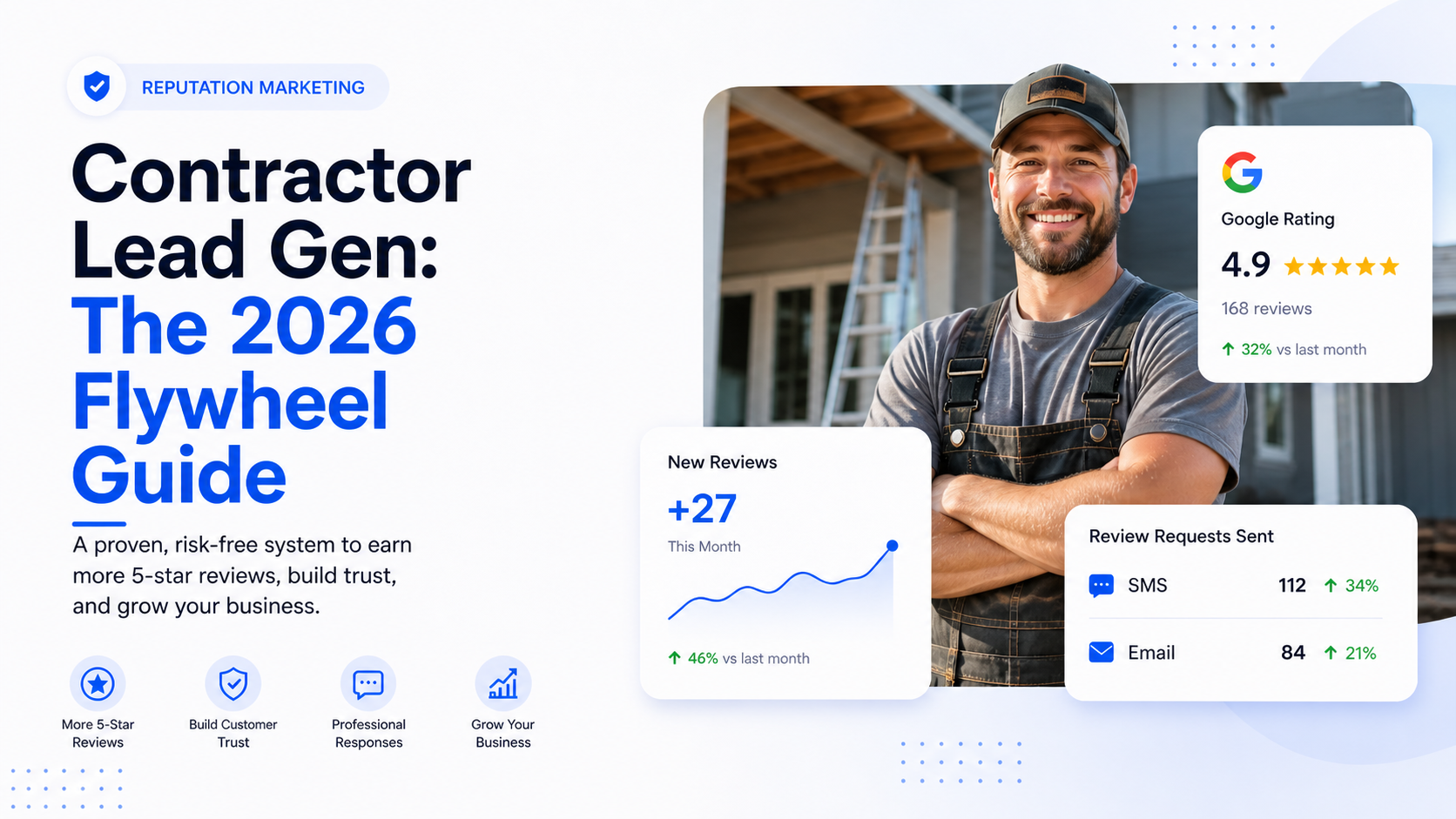
Contractor Lead Gen: The 2026 Flywheel Guide
Learn how contractors can build a stronger lead generation flywheel using owned channels, reviews, Google Business Profile, CRM discipline, fast follow-up, and post-job proof.

William Peterson
Growth Marketing @ ReviewCatch
Most contractor lead gen advice starts in the wrong place.
It starts with channels, hacks, ad platforms, and lead vendors.
That is backwards.
A contractor does not need more random leads. A contractor needs a system that turns completed jobs into trust, trust into visibility, and visibility into better leads that cost less to win.
That is the real strategy.
Not buying another batch of shared leads and hoping someone answers the phone first.
The contractors that grow cleanly usually stop treating lead generation like a monthly purchase. They treat it like an asset they build and control.
Website. Google Business Profile. Reviews. Fast follow-up. CRM discipline. Sales tracking. A repeatable process after every completed job.
That is the flywheel.
When it works, each job helps create the next one.
What Contractor Lead Gen Really Means in 2026
Contractor lead gen is not just buying names from a lead marketplace.
It is the full system a contractor uses to attract, capture, qualify, follow up with, and convert potential customers into booked jobs.
That includes:
- Local SEO
- Google Business Profile
- Google Ads
- Website conversion
- Reviews
- Referrals
- Email and SMS follow-up
- CRM tracking
- Call handling
- Estimate follow-up
- Past customer reactivation
The mistake many contractors make is thinking lead generation ends when the phone rings.
It does not.
A lead is not revenue. A lead is only an opportunity.
If the office responds late, the website looks weak, the Google profile has stale reviews, the estimate follow-up is sloppy, or nobody tracks where booked jobs came from, the contractor lead gen system is leaking money.
A strong system does three things:
- Attracts the right prospects
- Converts them into booked jobs
- Turns completed jobs into proof that creates future leads
That third piece is where most contractors fall short.
They finish the job, collect payment, move on, and leave future trust on the table.
The Hidden Cost of Buying Contractor Leads
Buying contractor leads feels easy because it removes the hard work up front.
Sign up. Fund the account. Wait for leads.
The problem is that convenience hides ugly trade-offs.
Shared leads are rarely loyal. The homeowner may be talking to several contractors at once. The job turns into a race between whoever calls first, sounds cheapest, or pushes hardest.
That creates three problems:
- Price pressure goes up
- Close rates go down
- Brand control gets weaker
The contractor is paying for access, but not building much long-term value.
That does not mean paid lead sources are always useless. Sometimes they can fill schedule gaps. A new company may need short-term volume. A contractor entering a new market may use them temporarily.
But they should not become the core growth engine.
The longer a contractor depends on rented lead flow, the harder it becomes to build owned demand.
If a lead source does not strengthen your brand, your website, your reviews, your Google Business Profile, or your customer database, it is probably a short-term tool, not a long-term asset.
The real cost of bought leads is not only the price per lead.
The deeper cost is dependency.
If the lead platform changes pricing, lowers quality, increases competition, or cuts off the account, the contractor has no real asset to fall back on.
That is why the better approach is not “never buy leads.”
The better approach is to use paid or rented channels carefully while building a contractor lead gen flywheel you own.
The Contractor Lead Gen Flywheel
A stronger contractor lead gen model works like a flywheel.
Here is the simple version:
- A homeowner finds the contractor through search, referral, ads, or word of mouth.
- The contractor responds quickly and books the estimate or job.
- The team delivers a professional customer experience.
- The customer leaves a review after the job is complete.
- The review improves trust on Google, the website, and future sales conversations.
- Better trust improves visibility, conversion, and referral confidence.
- More qualified leads come in at a lower effective cost.
That is how completed work starts producing future demand.
A plumber who finishes a drain cleaning job should not only send the invoice and leave. That job can produce a review, a job photo, a service page testimonial, and a stronger Google Business Profile.
An HVAC company that completes a furnace repair should not let the customer disappear silently. That completed service should trigger a review request, a follow-up message, and possibly a future maintenance reminder.
A roofer who finishes a repair should capture project photos, request a review, and use that proof on roof repair pages, local service pages, and sales materials.
That is the flywheel.
Jobs create proof.
Proof creates trust.
Trust creates better leads.
Build Your Digital Foundation First
Contractors do not fix a weak lead gen system by buying more traffic.
They fix it by building assets that turn existing demand into calls, quote requests, and booked jobs.
That starts with the digital foundation.
If a homeowner searches your company, clicks through, and finds a thin website, outdated Google Business Profile, stale reviews, and no clear contact path, the sale gets harder before anyone speaks to them.
Good traffic cannot rescue weak trust signals.
It only sends more people into the same conversion problem.
Your Website Has One Job
A contractor website is not there to win design awards.
It is there to turn visitors into leads.
A visitor should be able to confirm four things quickly:
- What you do
- Where you work
- Why you can be trusted
- How to contact you
If any of that takes effort, the site is costing you leads.
A solid contractor website should include:
- Service-specific pages
- Clear service areas
- Click-to-call buttons
- Short quote or booking forms
- Recent reviews
- Real project photos
- Crew or team photos
- Licensing, insurance, warranty, or certification details
- FAQs that reduce hesitation
- Strong calls to action on every important page
Generic service pages do not convert well.
A plumbing company should not rely on one page called “Plumbing Services.” It should have pages for drain cleaning, water heater replacement, leak detection, emergency plumbing, sump pumps, and any other profitable service.
An HVAC company should have separate pages for furnace repair, AC repair, heat pump installation, maintenance, emergency HVAC service, and replacement estimates.
A roofer should have pages for roof repair, roof replacement, storm damage, leak repair, inspections, and commercial roofing if relevant.
Specific pages match specific intent.
Specific intent creates better leads.
Google Business Profile Is Part of the Sales Process
For many contractors, Google Business Profile gets seen before the website does.
Homeowners scan the profile directly in search and Maps. They look at the rating, review count, photos, service areas, hours, and how recently the business has been reviewed.
If the profile looks neglected, trust drops.
A strong Google Business Profile should have:
- Correct primary and secondary categories
- Accurate phone number and website
- Current hours
- Clear service areas
- Specific services listed
- Real photos from jobs
- Recent customer reviews
- Professional review responses
- No obvious duplicate listing problems
- A business description that clearly explains the services and market
This matters because Google Business Profile is not just an SEO asset.
It is a conversion asset.
A homeowner comparing three contractors may never read the full website before calling. The profile itself may do most of the trust work.
That makes reviews, photos, and profile accuracy part of the contractor lead gen system.
Reviews Are Fuel, Not Decoration
Reviews are not just something nice to display.
They are one of the main trust signals that power contractor lead gen.
Each completed job should create proof.
That proof helps the next homeowner trust the business faster.
That trust improves conversion from:
- Google Business Profile views
- Local SEO traffic
- Branded search
- Referral traffic
- Paid ads
- Website quote forms
- Sales calls
- Estimate follow-up
That is why review generation cannot depend on memory.
It needs a process.
A practical contractor review system includes:
- Asking after the job is complete
- Sending the request while the experience is fresh
- Using SMS and email
- Sending a direct review link
- Following up once if appropriate
- Avoiding pressure or incentives
- Training staff to mention the request naturally
- Monitoring new reviews
- Responding professionally
A contractor with average ads and a strong review system can often outperform a competitor with better ad creative and weak proof.
The reason is simple.
Trust improves every channel.
Run a Foundation Audit Before Adding More Channels
Before spending more on SEO, PPC, Local Services Ads, social ads, or lead vendors, check whether your foundation can convert the attention you already have.
| Asset | What to Check | What Bad Looks Like |
|---|---|---|
| Website | Clear services, clear service area, obvious contact path, mobile speed, reviews, project photos | Generic homepage, thin service pages, slow mobile load, hidden phone number |
| Google Business Profile | Correct categories, updated photos, complete services, accurate hours, recent reviews | Incomplete profile, stale photos, missing services, mismatched details |
| Reviews | Recent reviews, steady volume, job-specific comments, response activity | Long gaps, low volume, generic reviews, no request system |
| Follow-up | Fast response, clear next step, estimate reminders, CRM tasks | Missed calls, slow replies, no pipeline visibility |
| Tracking | Source tracking, booked rate, close rate, review generation | Guessing which channels work |
This work is less exciting than chasing the next lead source.
It also pays better.
A strong foundation lowers the cost of every future lead.
The Best Contractor Lead Gen Channels in 2026
The best contractor lead gen channel depends on the trade, market, job value, urgency, and follow-up capacity.
But the channels should not be treated equally.
Some build long-term assets.
Some create short-term volume.
Some do both if managed well.
Some keep the contractor dependent.
Contractor Lead Gen Channel Comparison
| Channel | Cost | Lead Quality | Time to Results | Best For |
|---|---|---|---|---|
| Local SEO and Google Business Profile | Lower direct media cost, ongoing effort cost | Strong when intent is high | Slower | Long-term inbound demand |
| Google Ads | Can get expensive in competitive markets | Strong if tightly targeted | Fast | Emergency services and high-intent searches |
| Local Services Ads | Pay-per-lead model, quality varies | Can be strong, but competitive | Fast | High-urgency local services |
| Facebook and Instagram Ads | Flexible spend, creative-dependent | Mixed, usually colder | Moderate | Visual trades, offers, seasonal campaigns |
| Content Marketing | Time-heavy at first | Strong when matched to buyer questions | Slower | Long-term SEO and sales support |
| Referrals | Low direct cost | Usually excellent | Variable | Contractors with happy customers and strong relationships |
| Lead Aggregators | Ongoing spend, weak ownership | Inconsistent | Fast | Temporary gap filling |
The mistake is not using multiple channels.
The mistake is using them without clear roles.
A strong contractor lead gen system should know:
- Which channels create calls
- Which channels create booked jobs
- Which channels create profitable jobs
- Which jobs turn into reviews
- Which reviews improve future lead quality
Lead volume alone is not enough.
The contractor needs lead quality, booked jobs, completed work, and proof creation.
Where Local SEO Earns Its Keep
Local SEO earns its keep by producing leads with context.
The homeowner searched for a real problem. They saw the company in Maps or organic search. They checked reviews. They looked at recent work. They reached out with some trust already built.
That is a better sales conversation than a shared lead where five companies are chasing the same homeowner.
A contractor using local SEO well usually focuses on:
- Service pages tied to real search intent
- Location relevance
- Google Business Profile optimization
- Review generation
- Project photos
- Internal linking between related services
- FAQs that answer buyer objections
- Clear contact options on mobile
SEO is slower than paid traffic, but it compounds.
Every completed job can strengthen future SEO if the contractor turns it into photos, reviews, service-page proof, and local trust signals.
When Google Ads Makes Sense
Google Ads can work extremely well for contractors with urgent services.
Examples include:
- Emergency plumbing
- Furnace repair
- AC repair
- Electrical troubleshooting
- Water damage
- Roof leak repair
- Garage door repair
- Appliance repair
- Locksmith services
In urgent categories, the customer needs help now.
That means paid search can capture high-intent demand quickly.
But Google Ads can also burn money fast.
Common problems include:
- Broad keywords
- Weak negative keyword lists
- Generic landing pages
- Slow callback times
- Poor call tracking
- No estimate follow-up
- No clear service area controls
- Sending paid traffic to weak pages
Paid traffic exposes operational problems.
It does not fix them.
If the phone is missed, the form is too long, the page is generic, or the office follows up late, Google Ads becomes expensive fast.
When Social Ads Make Sense
Facebook and Instagram are usually not as high-intent as Google Search.
People scrolling social media are not always looking for a contractor right now.
But social ads can still work well for certain contractor categories.
They are especially useful for:
- Remodelers
- Landscapers
- Roofers after storms
- Exterior contractors
- Painters
- Deck builders
- Fencing companies
- Window and door companies
- Seasonal maintenance offers
Social works best when the visual proof is strong.
Before-and-after photos, project galleries, neighborhood targeting, and seasonal offers can all help.
But the follow-up has to be tight.
Social leads are often colder. They need faster qualification, clearer offers, and better nurture.
Why Referrals Still Matter
Referrals are still one of the highest-quality contractor lead gen sources.
The trust is already partly built before the customer calls.
But referrals should not be passive.
Contractors can build referral flow by:
- Asking happy customers after completion
- Keeping in touch with past customers
- Building relationships with property managers
- Partnering with complementary trades
- Sending thank-you messages after referrals
- Making the referral process simple
- Using reviews to support word-of-mouth trust
A referral works even better when the person looks up the contractor and finds strong reviews, recent photos, and a polished profile.
That is the point.
Reviews make referrals easier to trust.
Contractor Lead Gen Mistakes That Keep Costs High
Most contractors do not have one lead gen problem.
They have several small leaks that compound.
Mistake 1: Depending Only on Lead Aggregators
Lead aggregators can create short-term volume, but they rarely build long-term equity.
If most leads come from platforms the contractor does not control, the business is exposed.
A healthier model uses aggregators only as a temporary supplement while building owned channels.
Mistake 2: Having Generic Service Pages
A generic “Services” page does not match how homeowners search.
People search for specific problems.
“Water heater leaking.”
“AC not cooling.”
“Roof leak repair.”
“Panel upgrade.”
“Basement renovation contractor.”
The website should match those searches with specific pages.
Mistake 3: Responding Too Slowly
Homeowners often contact more than one contractor.
If the office waits too long, the lead may already be booked elsewhere.
Fast response does not mean being pushy.
It means being organized.
Mistake 4: No CRM Discipline
If leads live in email inboxes, voicemail, paper notes, and random text threads, the business will lose opportunities.
Every inquiry should enter one pipeline.
Every lead should have an owner.
Every estimate should have a follow-up task.
Mistake 5: No Review Process
A contractor that does good work but does not ask for reviews consistently is leaving trust on the table.
That hurts Google Business Profile performance, website conversion, referrals, and paid ad efficiency.
Mistake 6: Not Tracking Booked Jobs by Source
Lead source tracking should not stop at inquiries.
The contractor needs to know which sources produce:
- Booked calls
- Completed jobs
- Profitable work
- Reviews
- Repeat customers
- Referrals
A channel that produces cheap leads but bad jobs is not cheap.
Actionable Contractor Lead Gen Playbooks
A strategy only matters if a contractor can actually run it.
Here are two practical playbooks.
Playbook 1: The Neighborhood Dominator
This works well for plumbers, HVAC companies, electricians, roofers, cleaners, painters, landscapers, and other contractors serving defined local areas.
The idea is simple.
Pick the service areas you want to dominate and turn every completed job into local proof.
Weekly Actions
- Build or improve service pages for core services
- Add real project photos to the website and Google Business Profile
- Ask happy customers for reviews after completed jobs
- Respond to all new reviews
- Track every lead source
- Follow up on every unsold estimate
- Add strong reviews to service pages
- Watch which towns, services, and crews produce the best results
Why It Works
This playbook builds visibility inside the exact market where the contractor wants more work.
A homeowner sees the company in search, finds recent reviews, checks photos, reads service-specific proof, and calls with more trust.
That is a better conversation than a cold shared lead.
Playbook 2: The Advanced Project Hunter
This playbook is stronger for contractors looking for planned, higher-value projects.
Examples include:
- Roof replacement
- HVAC replacement
- Remodeling
- Additions
- Exterior work
- Commercial upgrades
- Specialty subcontracting
The goal is to identify project signals before the market becomes crowded.
Possible signals include:
- Permit activity
- Neighborhood project trends
- Storm damage zones
- Aging home stock
- Past customer databases
- Seasonal maintenance needs
- Property manager relationships
- Real estate transaction activity
How to Run It
- Choose a profitable service area.
- Identify the project types you want.
- Build a list of prospects or neighborhoods.
- Create a relevant offer or outreach angle.
- Push contacts into the CRM.
- Follow up with a useful, specific message.
- Track which outreach creates booked estimates.
- Turn completed jobs into reviews and project proof.
The win here comes from focus.
A smaller list with better fit beats a giant list of names that never should have entered the pipeline.
Build the Lead Management System
Most contractor lead gen breakdowns happen after the inquiry.
The business gets the lead, then loses it through slow routing, weak qualification, missed follow-up, or unclear next steps.
That is where tools matter.
Not because software is magic.
Because a good system prevents good leads from falling through the cracks.
Use a CRM as the Central Hub
A CRM should sit in the middle of the contractor lead gen system.
Depending on the business, that could be:
- Jobber
- Housecall Pro
- HubSpot
- Pipedrive
- Zoho
- Salesforce
- ServiceTitan
- Buildertrend
- A trade-specific platform
The CRM should answer basic questions:
- Where did this lead come from?
- What service do they need?
- How urgent is it?
- Who owns the next step?
- Was the estimate sent?
- Was follow-up completed?
- Did the job close?
- Did the customer leave a review?
Without that, the office runs on memory.
Memory does not scale.
Lead Scoring Keeps Crews Focused
Not every lead deserves the same urgency.
A contractor should score or prioritize leads based on practical fit.
Useful criteria include:
- Service fit
- Urgency
- Location
- Project size
- Timeline
- Budget signal
- Repeat customer status
- Referral source
- Availability of crew capacity
A $12,000 roof repair opportunity in the core service area should not be treated the same as a vague inquiry outside the service radius.
Lead scoring keeps the office focused on the work the business actually wants.
Automation Should Remove Lag, Not Humanity
Automation should not make the company feel robotic.
It should make the company feel organized.
A good automated system can:
- Create the lead record
- Assign the right person
- Send a fast acknowledgment
- Trigger follow-up tasks
- Remind the customer of appointments
- Flag stale opportunities
- Trigger review requests after completed jobs
The customer does not care that the process is automated.
They care that the contractor responds quickly, communicates clearly, and follows through.
The best contractor lead gen system does not feel automated to the customer. It feels fast, organized, and professional.
From Inquiry to Booked Job: The Conversion Playbook
A lead is not revenue.
It is a chance.
The gap between those two things is where many contractors lose money.
They paid to get attention, then answered too late, followed up loosely, or never created a clear next step.
The First Contact Should Do One Thing
The first response does not need to sell the whole job.
It needs to move the lead to the next step.
That next step might be:
- A phone call
- A diagnostic appointment
- A site visit
- An estimate slot
- A short qualification exchange by text
- A photo request
- A quote review call
What fails is vague follow-up.
“Thanks, we’ll be in touch” is not a sales process.
It is a stall.
Practical Response Templates
Initial SMS for Urgent Service
Hi [Name], this is [Company]. Thanks for reaching out about [service need]. A team member can help with that. Is this an urgent issue, and what is the best address for service?
Initial SMS for Estimate Requests
Hi [Name], this is [Company]. Thanks for requesting an estimate for [project type]. A team member can help schedule the next step. What day works best for a quick call or site visit?
Follow-Up When the Lead Goes Quiet
Hi [Name], checking back on your request for [service/project]. If timing still makes sense, [Company] can help with next steps. Reply here and the office will get it scheduled.
Re-Engagement Template for Older Estimates
Hi [Name], this is [Company]. Reaching out in case you are still considering the [project/service] estimate. If questions came up or timing changed, the office can update the scope and help with next steps.
These messages work because they are short, useful, and clear.
They do not sound desperate.
They sound organized.
What the Office Should Avoid
The biggest mistakes are predictable:
- Calling once and giving up
- Sending long generic emails
- Not qualifying the job
- Failing to confirm the next step
- Letting old estimates die
- Not tracking outcome by source
- Not sending reminders
- Not asking for reviews after completed work
A lot of homeowners are not ready at the exact moment they inquire.
That does not make them bad leads.
It means the contractor needs a light follow-up process.
Close the Loop: Turn Every Job Into More Leads
Most contractors treat the job as the finish line.
It should be the start of the next sales cycle.
A completed job creates the best marketing material a contractor can get.
The customer has direct experience.
The work is fresh.
The trust is real.
If the contractor captures that moment correctly, one job helps produce the next one.
Reviews Are the Output That Feeds the Input
The cleanest way to reduce dependence on bought leads is to grow direct trust signals after each completed job.
That means building a post-job process that asks for reviews consistently, at the right time, and through the right channels.
For many contractors, that means automated SMS and email tied to the CRM or booking workflow.
This is not just about collecting praise.
It improves the entire lead engine:
- Google Business Profile gets fresh activity
- Future searchers see recent proof
- Website visitors trust the company faster
- Sales conversations start warmer
- Referrals become easier
- Paid ads convert better
- Service pages feel more credible
That is why reviews should not sit outside the contractor lead gen system.
They should be part of operations.
What Different Contractors Should Prioritize
Different trades should not run the same lead gen plan.
Plumbers
Prioritize urgent local SEO, Google Business Profile visibility, fast call handling, and automated review requests after completed service calls.
HVAC Companies
Prioritize seasonal campaigns, emergency repair visibility, replacement estimate follow-up, maintenance plan reactivation, and review requests after completed repairs or installs.
Roofers
Prioritize project photos, storm-related local pages, estimate follow-up, neighborhood proof, reviews after completed repairs, and referral relationships.
Electricians
Prioritize service-specific pages, trust signals, fast qualification, and clear explanation of job types because electrical requests vary widely.
Remodelers
Prioritize project galleries, longer sales follow-up, testimonials, proposal nurturing, and reviews that mention communication, cleanliness, timeline, and quality.
Landscapers
Prioritize seasonal offers, recurring customer reviews, visual proof, local service pages, and referral prompts.
Cleaners
Prioritize recurring customer cadence, review cooldown rules, service-area pages, and strong follow-up after first-time appointments.
Measure What the Business Actually Owns
The easiest trap is overvaluing lead volume and undervaluing lead quality.
A smarter view tracks which sources lead to booked jobs, completed work, and review generation.
The best contractor lead gen scorecard includes:
- Lead source
- Cost per lead
- Booked rate
- Show rate
- Close rate
- Average job value
- Gross margin by source
- Review generation after completion
- Repeat customer rate
- Referral activity
A lead source is stronger when it produces jobs that produce proof.
That is the standard.
Not just “how many leads did we get?”
The better question is:
Which sources produce profitable jobs that strengthen the flywheel?
Where ReviewCatch Fits
ReviewCatch helps local service businesses turn completed jobs into more Google reviews without adding manual follow-up to the office workload.
That matters because most contractors do not have a reputation problem.
They have a process problem.
The work gets done. The customer is happy. The crew moves on. The office gets busy. The review request never goes out.
ReviewCatch helps close that gap.
It can help contractors:
- Send review requests after real customer interactions
- Use SMS and email follow-ups
- Connect review requests to completed jobs, bookings, invoices, or customer records
- Apply cooldown rules for repeat customers
- Track review activity by location, team, or workflow
- Monitor new reviews
- Respond faster
- Display reviews on the website
- Keep review generation from depending on staff memory
ReviewCatch does not create a good reputation by itself.
The contractor still has to do good work.
But when the work is good, ReviewCatch helps make sure satisfied customers have a simple path to leave public proof.
That proof strengthens Google Business Profile, website conversion, referrals, and future lead quality.
In other words, ReviewCatch helps power the review layer of the contractor lead gen flywheel.
Contractor Lead Gen FAQs
What is contractor lead gen?
Contractor lead gen is the process of attracting, capturing, qualifying, following up with, and converting potential customers into booked contractor jobs. A strong system includes channels like local SEO, Google Business Profile, paid ads, referrals, reviews, website conversion, CRM tracking, and post-job follow-up.
What is the best lead generation channel for contractors?
For most contractors, the best long-term channel is a combination of local SEO, Google Business Profile, and reviews. Paid ads can create faster demand, but owned channels usually create more durable lead flow over time.
Are contractor lead aggregators worth it?
Lead aggregators can be useful for temporary volume, but they should not become the main growth engine. Shared leads often create price pressure, weak brand ownership, and inconsistent quality. Contractors should use them carefully while building owned demand.
How do reviews help contractor lead gen?
Reviews improve trust before the sales conversation starts. They help Google Business Profile look stronger, make website visitors more confident, support referrals, and improve conversion from paid and organic traffic. Fresh reviews also show that the contractor is active and trusted by recent customers.
How fast should contractors respond to new leads?
As fast as possible. Many homeowners contact multiple contractors, so slow response creates lost opportunities. The office should have a clear process for immediate acknowledgment, qualification, scheduling, and follow-up.
How can contractors get more leads without buying shared leads?
Contractors can build owned lead flow by improving their website, optimizing Google Business Profile, collecting more reviews, building service-specific pages, tracking lead sources, following up on estimates, asking for referrals, and turning completed jobs into ongoing proof.
Final Takeaway
Contractor lead gen is not about chasing more random names.
It is about building a system that turns attention into booked jobs and booked jobs into future trust.
The contractors that win in 2026 will not be the ones buying the most leads.
They will be the ones building the best flywheel.
They will have clear service pages, strong Google Business Profiles, recent reviews, fast follow-up, CRM discipline, estimate nurturing, source tracking, and a repeatable review process after every completed job.
That is how contractor lead gen gets cheaper, cleaner, and more durable.
The job creates proof.
The proof creates trust.
The trust creates better leads.
And the business becomes less dependent on rented platforms every month.
If your contractor lead gen system stops after the invoice is paid, you are leaving future jobs on the table. ReviewCatch helps turn completed work into automated review requests, fresh Google reviews, stronger trust signals, and a repeatable reputation flywheel that supports long-term growth.
Ready to turn completed jobs into more leads?
ReviewCatch helps contractors send review requests, follow up with customers, monitor new reviews, display reviews on their website, and build a stronger contractor lead gen flywheel.
Build your review flywheel with ReviewCatch