
How to Respond to Google Reviews: Examples for Local Businesses
Learn how to reply to positive, neutral, negative, fake, and sensitive Google reviews with practical examples local businesses can use.

William Peterson
Growth Marketing @ ReviewCatch
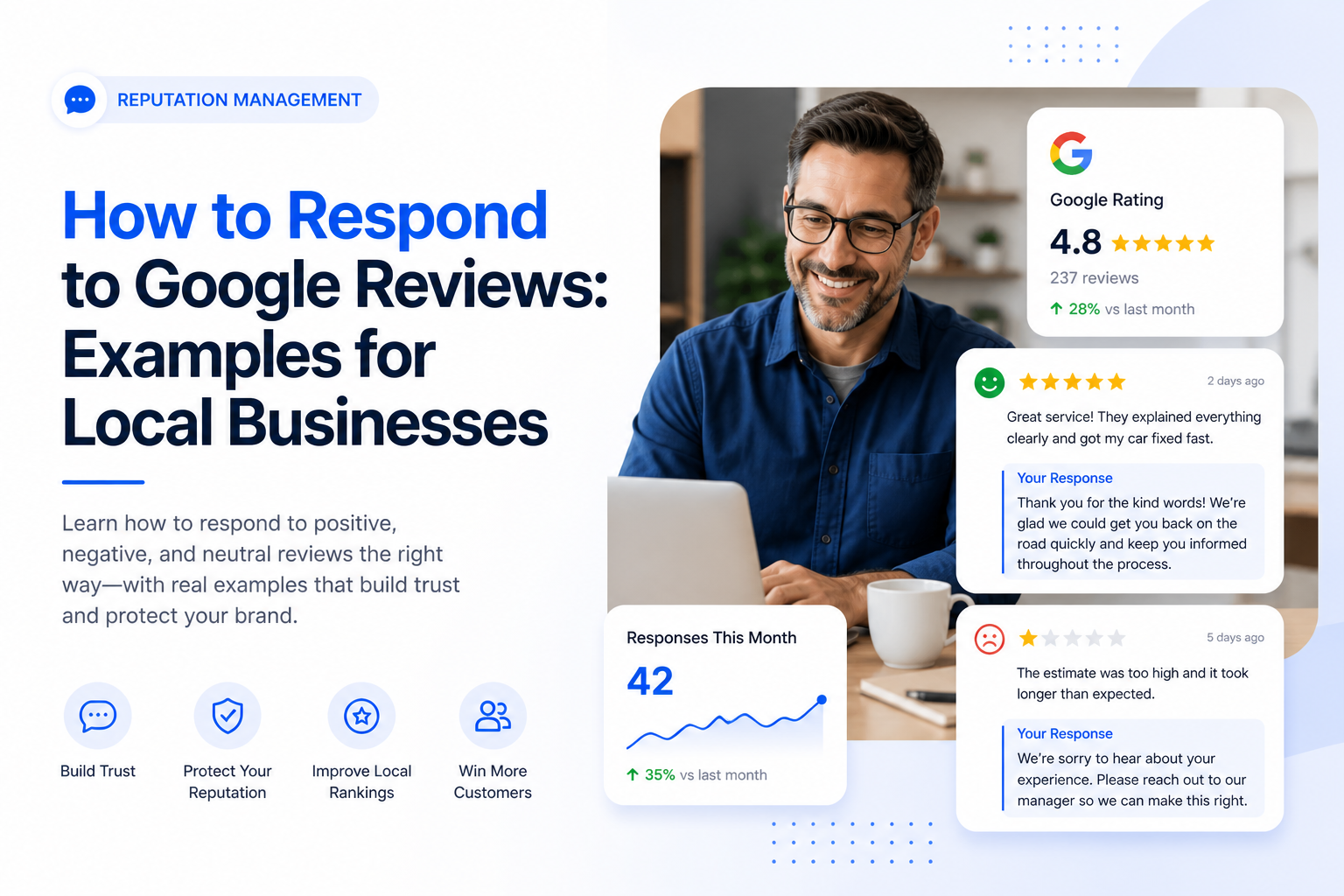
Most local business owners treat Google review replies like cleanup work.
That is the wrong way to look at it.
A review response is not just a message to the person who left the review. It is a public signal to every future customer comparing your business against the next option on Google.
A homeowner looking for an HVAC company, a driver choosing an auto repair shop, a patient comparing clinics, or a property manager looking for a contractor is not only reading the star rating. They are watching how the business behaves in public.
Do you thank customers properly?
Do you respond when something goes wrong?
Do you sound calm, professional, and accountable?
Or do you look defensive, robotic, or absent?
That matters because reviews are now part of the buying journey. BrightLocal’s Local Consumer Review Survey found that 97% of consumers read reviews for local businesses, 85% are more likely to use a business after reading positive reviews, and 89% expect business owners to respond to reviews.
Google also encourages businesses to read and reply to reviews. Even if review replies are not a magic ranking lever, they help your Google Business Profile look active, maintained, and trustworthy.
A review response is written for the reviewer, but it is judged by the next customer.
This guide shows how to respond to positive, neutral, negative, fake, and sensitive Google reviews without sounding canned or making the situation worse.
Why Review Responses Matter for Local Businesses
For local service businesses, trust usually comes before the phone call.
A customer may not know your team yet. They may not understand your process. They may not know whether your pricing is fair or whether your technicians show up on time.
So they look for clues.
Google reviews provide those clues. Your replies add another layer.
When a business responds consistently, three things happen:
- The business looks active. A profile with recent replies feels maintained.
- The business looks reachable. Customers can see that someone is paying attention.
- The business looks more trustworthy. Professional replies show how the company handles praise, mistakes, and frustration.
Silence sends a message too.
A business with strong reviews but no replies can look detached. A business with mixed reviews and calm, specific replies can sometimes look more trustworthy because customers can see accountability.
That is especially important in industries where customers feel risk:
- Home services
- Auto repair
- Healthcare and wellness
- Dental and medical clinics
- Legal and professional services
- Contractors and trades
- Property services
- Multi-location local brands
A customer does not need perfection. They need confidence.
Good review responses build that confidence.
The 4-Part Google Review Response Framework
The best review replies are not long. They are controlled.
A strong response usually follows four parts:
- Acknowledge the review
- Reference one specific detail
- Reinforce the business standard
- Close with a natural next step
Not every review needs all four parts. A blank five-star rating can get a short thank-you. A detailed complaint needs more care.
The framework keeps your team from improvising emotionally.
1. Acknowledge the review
Start by showing the customer was heard.
For positive reviews, that usually means a direct thank-you.
For negative reviews, it means acknowledging the concern without immediately arguing.
Examples:
Thanks for the kind words, Sarah.
Thank you for taking the time to share this feedback.
We are sorry to hear the visit did not meet expectations.
The first sentence sets the tone. Keep it calm.
2. Reference one specific detail
Specificity is what separates a real response from a canned one.
If the customer mentions a furnace repair, tire service, roof inspection, dental cleaning, or landscaping job, mention that detail naturally.
Example:
We are glad the furnace repair was completed smoothly and that the technician explained the issue clearly.
That tells future customers the business actually read the review.
3. Reinforce the business standard
Use the response to quietly reinforce what your business wants to be known for.
Examples include clear communication, fast scheduling, clean work, honest estimates, friendly service, professional technicians, and thorough follow-up.
Example:
Clear communication is something our team takes seriously, so it is great to hear that came through.
Do not overdo this. One sentence is enough.
4. Close with a natural next step
For positive reviews, invite the customer back if it fits.
For negative reviews, move the conversation offline.
Examples:
We appreciate your support and look forward to helping again next time.
Please contact our office so a manager can review what happened and work toward a resolution.
The point is not to write a speech. The point is to make the business look professional.
How to Respond to Positive Google Reviews
Positive reviews are public proof.
The customer already said something valuable. Your response should thank them, reinforce the specific positive point, and keep the tone human.
Do not waste strong reviews with robotic replies like:
Thank you for your feedback.
That is better than nothing, but it does not add much.
A better reply reflects the actual service.
Example: 5-star review with details
Customer review:
Great service. Mike showed up on time, explained the repair clearly, and had our AC running again the same day.
Good response:
Thanks for the kind words, Sarah. We are glad Mike was able to get the AC repair handled quickly and explain everything clearly. The team appreciates you choosing us.
Why it works:
- It thanks the customer.
- It mentions the technician.
- It reinforces same-day repair and clear communication.
- It stays short.
Example: 5-star review with no text
Customer review:
★★★★★
Good response:
Thanks for the five stars, James. We appreciate your support.
A blank rating does not need a long reply. Keep it simple.
Example: review praising a staff member
Customer review:
Amanda at the front desk was amazing. She kept me updated and made the whole process easy.
Good response:
Thanks, Melissa. We are happy to hear Amanda made the process easier and kept you updated. Clear communication matters to our team, and we appreciate you sharing this.
This kind of reply is useful because it reinforces the customer experience you want future buyers to notice.
Example: review mentioning price or value
Customer review:
Fair price, no surprises, and the work was done faster than expected.
Good response:
Thanks, David. We are glad the pricing felt clear and the work was completed quickly. We appreciate you trusting our team.
This is better than saying “we are the cheapest,” which can cheapen the brand.
How to Respond to Neutral or Mixed Reviews
Neutral reviews can be more useful than they look.
A three-star or four-star review often includes practical feedback without the heat of a one-star complaint. The goal is to thank the customer, acknowledge the mixed experience, and invite more detail if needed.
Do not sound offended.
A four-star review is not an attack. It is a chance to learn what would have made the experience better.
Example: 4-star review
Customer review:
Good service overall. The repair was done well, but communication could have been better.
Good response:
Thanks for the honest feedback, Maria. We are glad the repair was handled well, and we appreciate the note about communication. We will share this with the team so we can improve the experience next time.
Why it works:
- It does not argue.
- It acknowledges both the positive and negative parts.
- It shows future customers the business listens.
Example: 3-star review
Customer review:
The work was fine, but the appointment started late and I had to call twice for updates.
Good response:
Thank you for sharing this, Kevin. We are glad the work itself was completed properly, but we are sorry the timing and updates fell short. Please contact our office so a manager can review the visit and address what happened.
This keeps the public reply professional and moves the details offline.
How to Respond to Negative Google Reviews
Negative reviews are where businesses either earn trust or lose it.
The goal is not to win an argument in public.
The goal is to show future customers that your business responds calmly, takes concerns seriously, and has a process for fixing problems.
Use this sequence:
- Pause before replying
- Check the job record
- Acknowledge the concern
- Take the experience seriously
- Move the conversation offline
- Follow up internally
Do not reply while angry
If the review makes you furious, wait.
A defensive response can make a small issue look like a bigger culture problem. The customer may be wrong about some details, but future readers will judge your tone first.
Before replying, check:
- Customer name
- Service date
- Staff or technician notes
- Invoice or estimate history
- Prior communication
- Any unresolved complaint
Then write a calm public reply.
Example: angry 1-star review
Customer review:
Terrible experience. They were late, communication was awful, and I would never use them again.
Good response:
We are sorry to hear this experience fell short. Communication and timing matter to us, and we would like to review what happened. Please contact our office and ask for a manager so we can look into the visit and work toward a resolution.
Why it works:
- It does not argue.
- It acknowledges the issue.
- It names the business standards.
- It gives a next step.
Example: review about pricing
Customer review:
Way too expensive. I feel like I was overcharged.
Good response:
Thank you for the feedback. We are sorry to hear there was concern about the pricing. We aim to be clear about estimates and approvals, and we would like to review the details with you directly. Please contact our office so a manager can look into this.
Do not post invoice details publicly. Pricing complaints should usually move offline.
Example: review about late arrival
Customer review:
The technician showed up late and nobody called me.
Good response:
We are sorry for the delay and for the lack of communication. That is not the experience we want customers to have. Please contact our office so we can review the schedule notes and address this properly.
This owns the communication problem without over-explaining.
Example: review about poor communication
Customer review:
Work was okay, but getting updates was frustrating.
Good response:
Thanks for sharing this feedback. We are glad the work was completed, but we are sorry the updates were frustrating. Clear communication is important, and we will use this to improve our follow-up process.
This kind of review can reveal an operational issue. If multiple customers say the same thing, fix the process.
What Not to Say in Google Review Replies
Some responses make the business look worse than the review itself.
Avoid these lines:
- “You are not in our system.”
- “That is not true.”
- “You signed the estimate.”
- “We already explained this to you.”
- “Our technician said you were difficult.”
- “We have hundreds of happy customers.”
- “This is a fake review.”
- “Take this down or we will take legal action.”
Even when you are right, these replies usually look defensive.
Better alternatives:
| Avoid saying | Say this instead |
|---|---|
| You are not in our system. | We could not match this review to a customer record based on the information shown here. |
| That is not true. | We would like to review the details directly so we can better understand what happened. |
| You signed the estimate. | We are sorry there was concern about the estimate and would like to review the details with you. |
| This is fake. | We cannot verify this experience from the information provided, but we invite you to contact our office so we can investigate. |
| Call us if you care. | Please contact our office and ask for a manager so we can look into this properly. |
Public replies are not court filings. They are trust signals.
How to Respond to Fake or Unrecognized Reviews
Not every review is clearly tied to a real customer.
Sometimes the reviewer uses a nickname. Sometimes they reviewed the wrong location. Sometimes the complaint is vague. Sometimes it may be fake, spam, or from someone who never hired the business.
Do not accuse them of lying in public.
Do not reveal customer records.
Do not threaten them.
Use a factual, calm response and report the review to Google if it appears to violate policy.
When a review looks suspicious
Look for signs like:
- No matching customer name
- No matching address, invoice, appointment, or phone number
- Claims about services you do not offer
- Vague accusations with no details
- Review posted to the wrong location
- A pattern that suggests spam or competitor activity
That does not automatically prove the review is fake. It means you should investigate before apologizing for something you cannot verify.
Safe response template for an unrecognized review
Thanks for the feedback. We could not match this review to a customer record based on the information shown here. Please contact our office with your name, service date, and job address so we can look into this properly.
This response does four things:
- It stays calm.
- It avoids calling the reviewer fake.
- It shows future customers the business checked records.
- It gives a real customer a way to identify the job.
Safe response for a wrong-location review
Thanks for reaching out. Based on the details in this review, it looks like this may be for a different location or business. Please contact our office so we can help confirm and direct you to the right team.
Safe response for a vague review
Thank you for the feedback. We would like to understand what happened, but we need more information to identify the visit. Please contact our office with your name and service date so a manager can review this properly.
How to Handle Reviews With Private or Sensitive Details
Some reviews include personal, medical, legal, financial, or job-specific information that should not be repeated publicly.
In those cases, be extra careful.
Do not confirm private details.
Do not post account history.
Do not mention diagnosis, billing disputes, addresses, family issues, legal details, or anything that could expose customer information.
Sensitive review response template
Thank you for sharing your concerns. To protect your privacy, we cannot discuss account or service details in a public review response. Please contact our office directly so the appropriate manager can review this with you.
This protects the customer and the business.
Should You Respond to Every Google Review?
In most cases, yes.
At minimum, every detailed review should receive a response. Negative reviews should be prioritized. Short five-star reviews can get shorter replies.
The goal is not to write a custom essay for every rating. The goal is to show that the business is active and attentive without making the profile look robotic.
A practical response standard:
- Negative reviews: Respond as soon as possible after reviewing the facts.
- Detailed positive reviews: Respond with a specific thank-you.
- Blank five-star reviews: Respond briefly.
- Neutral reviews: Acknowledge the mixed experience and invite more detail.
- Suspicious reviews: Reply factually and report if appropriate.
The mistake is not using templates. Templates are useful.
The mistake is posting templates without judgment.
How to Scale Review Responses Without Sounding Robotic
Manual review management works until the business gets busy.
One location can manage replies manually for a while. But once there are multiple technicians, multiple locations, or a steady stream of reviews, things start slipping.
That creates two problems:
- Reviews go unanswered.
- Replies sound inconsistent depending on who wrote them.
A good system solves both without removing human judgment.
What to automate
Automation is useful for the repeatable parts:
- New review alerts
- Review routing by location
- Draft replies for simple positive reviews
- Negative review escalation
- Approval workflows
- Response tracking
- Unresolved issue reminders
What should stay human
Do not fully automate sensitive replies.
Keep human approval for:
- Angry negative reviews
- Possible fake reviews
- Refund or pricing disputes
- Legal or medical concerns
- Reviews mentioning staff misconduct
- Reviews containing private information
- Anything that could create liability or worsen the relationship
Automation should remove repetitive work. It should not remove judgment.
Build a review response playbook
A simple playbook keeps the team consistent.
Include:
- Approved tone
- Positive review templates
- Neutral review templates
- Negative review templates
- Fake or unrecognized review templates
- Escalation rules
- Privacy rules
- Who approves sensitive replies
- Target response times
This turns review management from a random admin task into a repeatable operating process.
Where ReviewCatch Fits
ReviewCatch helps local service businesses manage reviews as a workflow instead of an inbox chore.
For businesses that already use CRM, booking, dispatch, or invoicing tools, ReviewCatch can help connect review activity to the systems already running the business.
That can make it easier to:
- Monitor new Google reviews
- Get alerts when reviews come in
- Draft responses faster
- Route negative reviews for review before posting
- Keep response tone consistent across teams or locations
- Track which reviews still need attention
- Turn review management into a standard operating process
ReviewCatch does not replace human judgment.
It helps make sure review replies do not get missed, delayed, or handled differently by every person on the team.
For a local business, that matters because response consistency is part of brand consistency.
Final Takeaway
Responding to Google reviews is not busywork.
It is public customer service.
It is sales support.
It is brand protection.
It is also one of the easiest ways to make your Google Business Profile look active, professional, and trustworthy.
The best businesses do not reply emotionally, randomly, or with the same canned line every time. They use a system.
Thank happy customers. Acknowledge mixed feedback. Handle negative reviews calmly. Keep private details private. Treat fake or unrecognized reviews carefully. Use automation to move faster, but keep people involved where judgment matters.
A good review response will not fix bad service.
But when the service is good, a strong response system helps make that quality visible to the next customer deciding whether to call.
Ready to manage reviews without missing replies?
ReviewCatch helps local businesses monitor Google reviews, draft responses faster, route negative reviews for approval, and keep review management consistent across teams or locations.
Start managing your reviews with ReviewCatch