15 Reasons Google Reviews Matter for Contractors in 2026
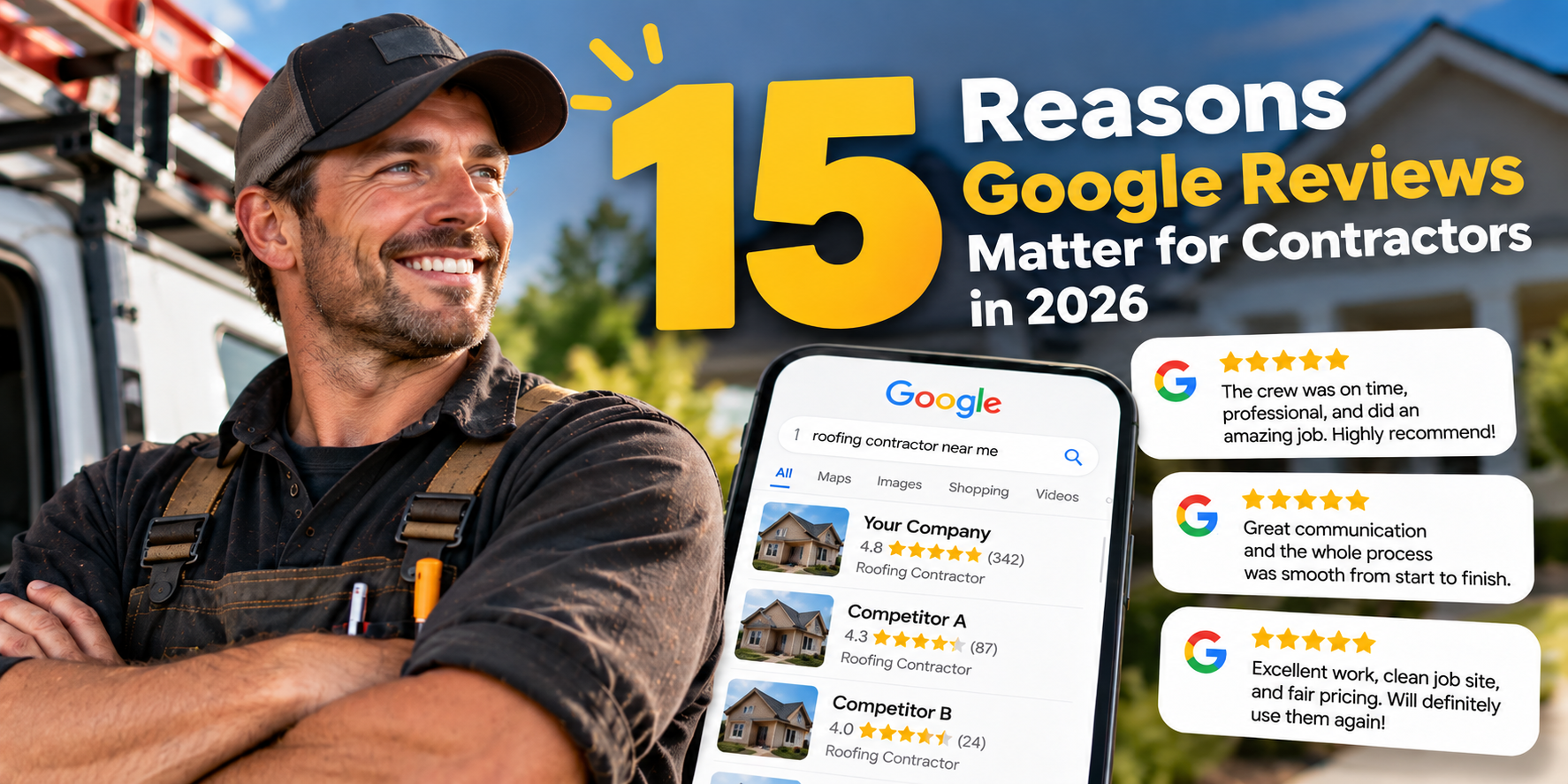
For contractors, Google reviews aren’t just a number beside the company name.
They affect how homeowners judge you before they ever call.
A homeowner looking for a roofer, plumber, electrician, HVAC company, landscaper, or remodeler may compare several businesses in a matter of minutes. They don’t know your crew. They haven’t seen your workmanship. They probably haven’t spoken to anyone in your office.
What they can see is your online reputation.
That usually includes:
- ✓Your star rating
- ✓Your total number of reviews
- ✓How recent those reviews are
- ✓What customers actually say
- ✓How you respond when something goes wrong
- ✓How your review profile compares with nearby contractors
Google itself says that more reviews and positive ratings can help a business’s local ranking. Google’s local results are mainly based on relevance, distance, and prominence, with reviews contributing to prominence.
But rankings are only one reason reviews matter.
Here are 15 reasons contractors should take Google reviews seriously in 2026.
Homeowners Use Reviews to Decide Who Makes the Shortlist
Most homeowners don’t call ten contractors.
They narrow the field quickly.
Recent BrightLocal research found that only 6% of consumers simply click the top search result. Star rating was one of the biggest factors people considered, followed closely by the number of reviews.
That means showing up on Google is only the first step.
You still have to look like a business worth contacting.
The second contractor might do excellent work, but the first one has much more visible proof behind its reputation.
Search Google for your three most valuable services and look at the businesses customers are likely to compare with you.
Write down their:
- Rating
- Review count
- Recent review activity
Then compare those numbers with your own.
That gives you a much more useful benchmark than deciding you simply “need more reviews.”
Reviews Reduce the Risk of Hiring a Contractor
Hiring a contractor requires trust.
A homeowner may be letting someone:
- Work inside their house
- Open walls
- Touch electrical or plumbing systems
- Replace expensive equipment
- Tear off a roof
- Dig up part of the property
- Manage a project worth tens of thousands of dollars
That’s a lot of uncertainty.
Reviews reduce some of it.
A homeowner can see whether previous customers say your crew:
- Showed up
- Communicated clearly
- Kept the property clean
- Finished the job properly
- Charged what was expected
- Returned calls
- Handled problems professionally
BrightLocal’s 2026 survey found that 85% of consumers said positive reviews make them more likely to use a business.
For contractors, trust isn’t a soft metric.
Trust gets the phone to ring.
Review Count Makes Your Rating More Believable
A 5.0 rating looks great.
But context matters.
Consider:
The second profile gives the homeowner far more evidence.
Hundreds of customers have interacted with that company and left feedback. That makes the reputation easier to judge.
BrightLocal’s 2026 consumer research found that review quantity remains an important part of how people evaluate local businesses.
There isn’t a magic review total every contractor needs.
Your market determines what “strong” looks like.
A landscaper in a small town may look established with 120 reviews.
A plumber competing in a major city may be surrounded by companies with 500 or more.
Don’t chase an arbitrary number like 100 reviews.
Look at the companies actually competing for your customers.
Then build toward a review profile that puts you in the same conversation.
Google Says Reviews Can Help Local Rankings
This isn’t speculation.
Google says that more reviews and positive ratings can help your business’s local ranking.
That matters because local contractors depend heavily on searches like:
- plumber near me
- roofing company
- electrician near me
- HVAC repair
- landscaping contractor
- kitchen remodeler
Google explains that local rankings are mainly based on:
How closely the business matches the search.
How far the business is from the searcher.
How established or well-known the business appears.
Reviews are one part of prominence.
That doesn’t mean getting 50 more reviews automatically moves you to position one.
Google considers many signals.
But reviews are clearly part of the local visibility picture.
Reviews Can Help You Get Chosen Even When You Don’t Rank First
Contractors sometimes become obsessed with being number one in Google Maps.
Ranking matters, but customers don’t automatically choose the first result.
BrightLocal’s 2026 research found that location, star rating, review volume, business information, pricing, photos, and other factors all influence the final choice.
That means the contractor ranked third can still win the customer.
Imagine:
A homeowner may scroll past Company A even if it appears first.
Visibility gets you into the competition.
Your reputation helps you win it.
Recent Reviews Show That Your Company Is Still Performing Well
A contractor may have 400 reviews, but if the last one was written eight months ago, people notice.
Old reviews tell a homeowner what the company used to be like.
Recent reviews tell them what it’s like now.
Crews change.
Technicians change.
Office staff changes.
Ownership can change.
Service quality can improve or decline.
BrightLocal’s 2026 research found that consumers increasingly care about recent reviews, not just the lifetime total.
That’s why contractors should avoid the “review campaign” approach.
Don’t collect 50 reviews this month and then forget about reviews until next year.
A steady flow is much stronger.
Look at the last 90 days.
How many new Google reviews did you receive?
Divide that number by three.
That’s roughly your current monthly pace.
Now you know whether your review profile is actually growing.
Reviews Answer Questions Your Sales Team Gets Every Day
Contractor reviews often answer sales questions before your salesperson ever speaks to the homeowner.
Customers write things like:
“The crew showed up exactly when they said they would.”
“They explained every part of the repair before starting.”
“The yard was spotless after the roof was finished.”
“The electrician explained everything without trying to upsell us.”
Those comments address real concerns.
Homeowners wonder:
- Will they show up?
- Will they make a mess?
- Will the price suddenly change?
- Will someone explain the work?
- Can I trust the technician?
- What happens if something goes wrong?
You can write “Professional and reliable” on your website all day.
A customer describing those qualities carries much more weight.
Write down the five objections or questions you hear most often before a customer hires you.
Then read your reviews.
See how many of those concerns previous customers are already answering.
Reviews Matter for High-Ticket Contractor Jobs
Reviews aren’t only important for small purchases.
BrightLocal’s 2026 survey found that 27% of consumers had spent more than $1,000 after reading reviews, while 13% had spent more than $5,000.
That’s directly relevant to contractors.
People research reviews before spending serious money on:
- Roof replacements
- HVAC systems
- Electrical upgrades
- Renovations
- Windows
- Landscaping
- Flooring
- Plumbing projects
The higher the price, the more proof customers may want.
A homeowner about to spend $20,000 on a roof replacement may read ten, twenty, or thirty reviews before deciding who gets an estimate.
A strong review profile reduces some of the uncertainty surrounding that decision.
Reviews Can Push Prospects to Your Website
A review doesn’t always generate an immediate call.
Sometimes it gets the customer to investigate further.
BrightLocal’s 2026 survey found that 54% of consumers visit a business’s website after reading positive reviews.
That creates a common contractor customer journey:
Your reviews may be what gets the person onto your website in the first place.
That means the website needs to finish the job.
Check that it:
- Works properly on mobile
- Explains your services clearly
- Shows where you operate
- Makes the phone number obvious
- Has an easy quote form
- Loads quickly
- Shows real examples of your work
A strong review profile followed by a terrible website wastes the trust you just earned.
Reviews Can Reinforce Your Specialty Services
Contractors often want more of a particular type of job.
An electrician may want EV charger installations.
A plumber may want water heater jobs.
An HVAC contractor may want heat pump installations.
A roofer may want full replacements rather than small repairs.
Reviews can help potential customers see that other people have hired you for exactly that service.
Someone reading:
“They installed our EV charger and explained the entire setup.”
is going to pay attention if they’re looking for an EV charger installer.
Google also allows service businesses to list individual services on their Business Profiles, and those services may be highlighted for relevant searches.
The important part is not telling customers what to write.
List your services accurately.
Then let customers describe their experiences naturally.
Reviews Show How You Handle Problems
No contractor has a perfect customer experience every time.
Jobs get delayed.
Equipment fails.
Weather changes.
Materials arrive late.
Miscommunication happens.
What matters is how the company handles it.
A homeowner reading reviews may actually learn more from a well-handled complaint than another generic five-star review.
Suppose someone complains about a scheduling issue and the contractor responds calmly, acknowledges what happened, and explains how they’re fixing it.
That tells future customers something useful.
Compare that with a business owner arguing publicly with every unhappy customer.
Same review platform.
Completely different impression.
Check:
- The job notes
- Customer history
- Photos
- Invoice
- Employee involved
Then respond when you understand what happened.
Write for the future customer reading the exchange, not only the person who posted it.
Reviews Tell You What’s Happening Inside Your Company
Your Google reviews can become an unofficial operations report.
Read enough of them and patterns start showing up.
Customers may repeatedly praise:
- One technician
- Communication
- Punctuality
- Clean work
- Honest recommendations
- Fast response times
Or they may complain about:
- Missed arrival windows
- Poor office communication
- Scheduling
- Cleanup
- Unexpected charges
- Lack of follow-up
One complaint can be noise.
Five similar complaints probably aren’t.
Use reviews in:
- Staff meetings
- Technician coaching
- Dispatcher training
- Customer service improvements
- Sales training
The point isn’t to punish employees every time someone leaves four stars.
It’s to notice recurring patterns.
Responding to Reviews Shows That Somebody Is Paying Attention
A Business Profile with hundreds of reviews and zero responses can feel neglected.
Google recommends replying to reviews and says that helpful responses can help a business stand out.
You don’t need to write a paragraph every time.
If someone says:
“Mike was on time and explained the electrical problem clearly.”
You might answer:
“Thanks, Sarah. Glad Mike was able to get everything sorted out and explain what was happening. We appreciate you calling us.”
That's enough.
Avoid posting this 200 times:
“Thank you for your five-star review! Customer satisfaction is our number-one priority!”
Customers know when something is copied.
Keep responses short and relevant.
Reviews Keep Working Long After the Job Is Finished
This is one of the strongest parts of a good review profile.
A contractor completes one job.
That customer leaves one review.
But that review may influence dozens or hundreds of future homeowners.
Unlike paid advertising, the review doesn’t disappear when you stop paying for the campaign.
It remains visible on your profile.
And the effect compounds.
If you average:
you add:
Maintain that pace for several years and your reputation starts looking very different from a competitor that gets one review here and another one two months later.
Consistency is what builds the asset.
Strong Reviews Make Every Other Marketing Channel Work Harder
Reviews don’t exist in isolation.
Someone may first hear about you through:
- Google Ads
- A yard sign
- A truck wrap
- A referral
- Direct mail
- YouTube
- Local sponsorship
- Door hangers
Then they search your company name.
What happens next?
They see your Google Business Profile.
If your advertising looks great but your profile has:
you've created friction.
If it has:
the advertising and reputation reinforce each other.
That’s why reviews shouldn’t be treated as a separate marketing tactic.
They're part of the proof behind everything else you do.
What Contractors Should Do Next
You don’t need to turn this into a complicated reputation project.
Start with the basics.
Record:
- Total Google reviews
- Average rating
- New reviews during the last 90 days
Then compare those numbers with several established competitors.
Google lets businesses create a direct review link and QR code from the Business Profile. Google recommends sharing it in places such as receipts and thank-you communications.
Test the link yourself before sending it.
Tie the request to a real customer milestone.
For example:
For bigger projects, wait until the final walkthrough.
For emergency service, wait until the problem has been resolved.
Something like:
Thanks for choosing [Business Name]. If you have a minute, we'd appreciate you sharing your experience on Google: [Review Link]
is enough.
A customer may forget.
One reminder a couple of days later is reasonable.
Then stop.
Google requires reviews to reflect genuine experiences and prohibits offering free or discounted products or services in exchange for reviews.
Don't:
- Buy reviews
- Offer discounts for reviews
- Ask specifically for five stars
- Tell customers what to write
- Only send the review link to happy customers
Don't only track the number.
Ask:
What are customers consistently praising?
What problems keep showing up?
Then use that information to improve the business.
Reviews Are Evidence
Contractors make a lot of claims.
“We do quality work.”
“We’re reliable.”
“We care about our customers.”
“We stand behind what we do.”
Every competitor says something similar.
Reviews give homeowners evidence.
They show whether customers felt respected.
Whether technicians showed up.
Whether crews cleaned up.
Whether the job was done properly.
Whether someone answered the phone when there was a problem.
That’s why Google reviews matter so much for contractors in 2026.
They can contribute to local visibility, help homeowners compare businesses, reduce the uncertainty around hiring you, and reinforce nearly every other form of marketing you’re already paying for.
You don't need to obsess over them.
You do need a system.
Do good work.
Ask consistently.
Make it easy for customers to respond.
Pay attention to what they tell you.
Then let that reputation build one completed job at a time.