4.8 Stars With 200 Reviews or 5.0 With 20: Which Looks More Trustworthy?
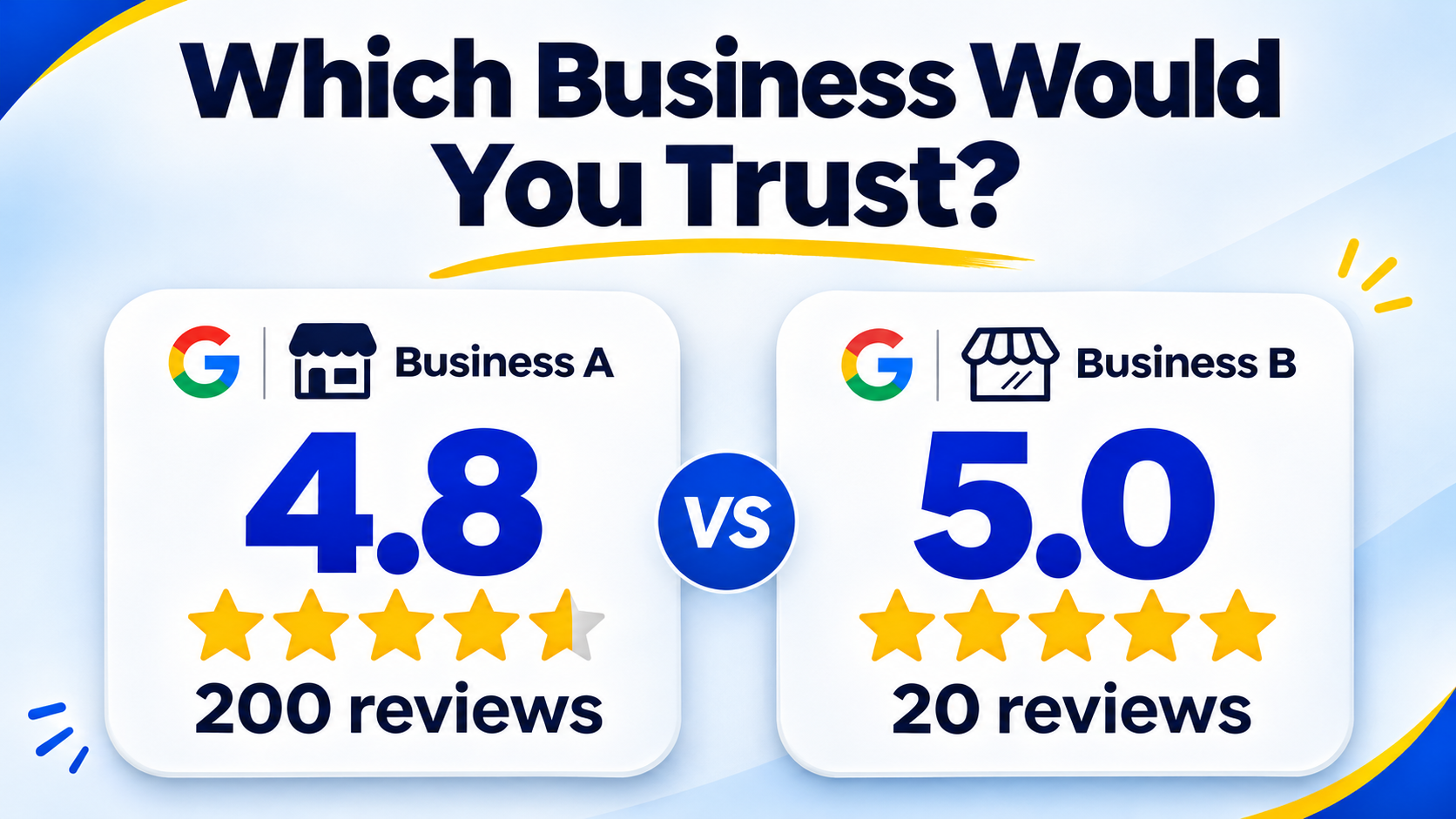
A 4.8-star business with 200 genuine reviews can make a stronger first impression than a 5.0-star business with 20. It combines a high rating with a much larger body of customer feedback.
The actual choice still depends on what those reviews say, how recent they are, and whether they describe the service the customer needs.
For a local business owner, that is useful perspective. A small drop from a perfect score can happen while your business is building a substantial record of positive experiences.
Here is how to assess the difference.
Rating and review volume tell customers different things
Imagine someone comparing two local contractors:
| Business | Google rating | Number of reviews |
|---|---|---|
| Contractor A | 4.8 | 200 |
| Contractor B | 5.0 | 20 |
Contractor B has the higher average. Contractor A has ten times as many reviews available to inspect.
Google calculates a business’s review score from the average of its published Google ratings.
Source: How Google calculates review scores
The average summarizes the ratings. The review count shows how much feedback sits behind that average.
A prospective customer reading Contractor A’s reviews has more opportunities to find experiences involving similar jobs, budgets, or concerns. That can help them assess consistency across the feedback.
The count alone does not establish authenticity or prove which contractor does better work. It also does not tell you how many jobs either company has completed.
Customers can consider businesses without a perfect score
BrightLocal’s 2026 Local Consumer Review Survey found that 10% of respondents said they would only use businesses with a five-star rating.
The survey used a representative panel of 1,002 US adults. It provides useful context about reported preferences, rather than a direct test of 4.8 stars with 200 reviews against 5.0 with 20.
Source: BrightLocal Local Consumer Review Survey 2026
For business owners, the practical implication is that a perfect score is not necessary to remain in consideration for every customer.
A strong rating supported by useful, credible feedback can still give someone confidence to contact you.
The written reviews can change the decision
A homeowner hiring a roofer may want to know whether the company communicated clearly, protected the property, and cleaned up after finishing.
A 4.8 average provides a starting point. The written reviews help answer those specific questions.
When comparing businesses, look for:
- Relevant work: Does the feedback describe projects similar to the customer’s?
- Recurring strengths: Do different customers independently describe similar positive experiences?
- Recent experiences: Is there feedback about work completed lately?
- Recurring complaints: Are several customers raising the same unresolved issue?
- Professional responses: Does the business address concerns clearly and respectfully?
Those details give the numbers context.
A complaint about one delayed arrival may carry different weight from repeated reports of unfinished work. Reading the feedback helps a customer understand that distinction.
When 5.0 stars with 20 reviews could look stronger
Consider a fictional comparison.
Contractor A has 200 reviews and a 4.8 rating. Most of its positive reviews are several years old, while recent feedback repeatedly mentions missed appointments and unanswered calls.
Contractor B has 20 reviews and a 5.0 rating. Its reviews are recent, describe the exact service the homeowner needs, and include detailed accounts of completed work.
In that situation, Contractor B could make the stronger impression.
A new or smaller business can have a legitimate perfect rating. Twenty genuine reviews can still provide useful evidence, especially when they are relevant to the job being considered.
Use the rating and count to begin the comparison, then read what sits behind them.
A larger review base makes the average less sensitive to one rating
There is also a mathematical difference between the two profiles.
Google’s average calculation means that a new rating has more influence when there are fewer existing ratings.
For illustration, assume the starting averages are exactly 5.00 and 4.80:
| Starting position | After one additional 1-star rating |
|---|---|
| 5.00 average across 20 ratings | Approximately 4.81 |
| 4.80 average across 200 ratings | Approximately 4.78 |
These are calculated averages before rounding for display.
The smaller profile experiences a larger change because the new rating represents a greater share of its total feedback.
That helps explain why maintaining a perfect average can become difficult as reviews accumulate. Keep addressing customer concerns and earning honest feedback as the business grows.
Does 4.8 with 200 reviews rank higher on Google?
The numbers alone cannot answer that.
Google says more reviews and positive ratings can help local ranking. It also considers relevance, distance, and prominence.
Its published guidance does not provide a formula proving that a business with 200 reviews will outrank one with 20.
Source: Google’s local ranking guidance
Customer trust and search visibility are related business concerns, but a comparison of two ratings cannot establish either company’s position in local results.
What should your business focus on?
If you have 20 reviews and a 5.0 rating, keep building your record. Give eligible customers a convenient opportunity to share their experiences as you complete more work.
If you have 200 reviews and a 4.8 rating, examine the recent feedback. Identify recurring problems, respond professionally, and keep collecting reviews from current customers.
In either case, useful priorities are to:
- Deliver work that earns positive feedback.
- Invite honest reviews consistently.
- Make the review link easy to access.
- Address repeated service issues.
- Keep your profile representative of the work you are doing today.
Google prohibits offering incentives for reviews and selectively soliciting positive reviews. Use a consistent invitation process that welcomes honest feedback.
Source: Google Maps review policies
Build your review record with ReviewCatch
ReviewCatch sends personalized Google review requests by text and email, with follow-ups to help you collect feedback consistently.
Make review requests part of completing a job and give future customers more experiences to consider when choosing your business.