Google Review Statistics: What the Numbers Actually Mean for Local Businesses
When someone searches for a local business, your website may not be the first thing they judge.
Your Google reviews might be.
Before calling, requesting a quote, visiting your website, or walking through the door, potential customers can see your star rating, total number of reviews, recent customer experiences, and how your business responds to feedback.
That gives customers a surprising amount of information before you've ever spoken to them.
But many Google review statistics repeated online are outdated, misquoted, or stripped of context. So we went back to recent consumer research and Google's own documentation to understand what the numbers actually tell local businesses.
Google Review Statistics at a Glance
Here are some of the numbers worth paying attention to:
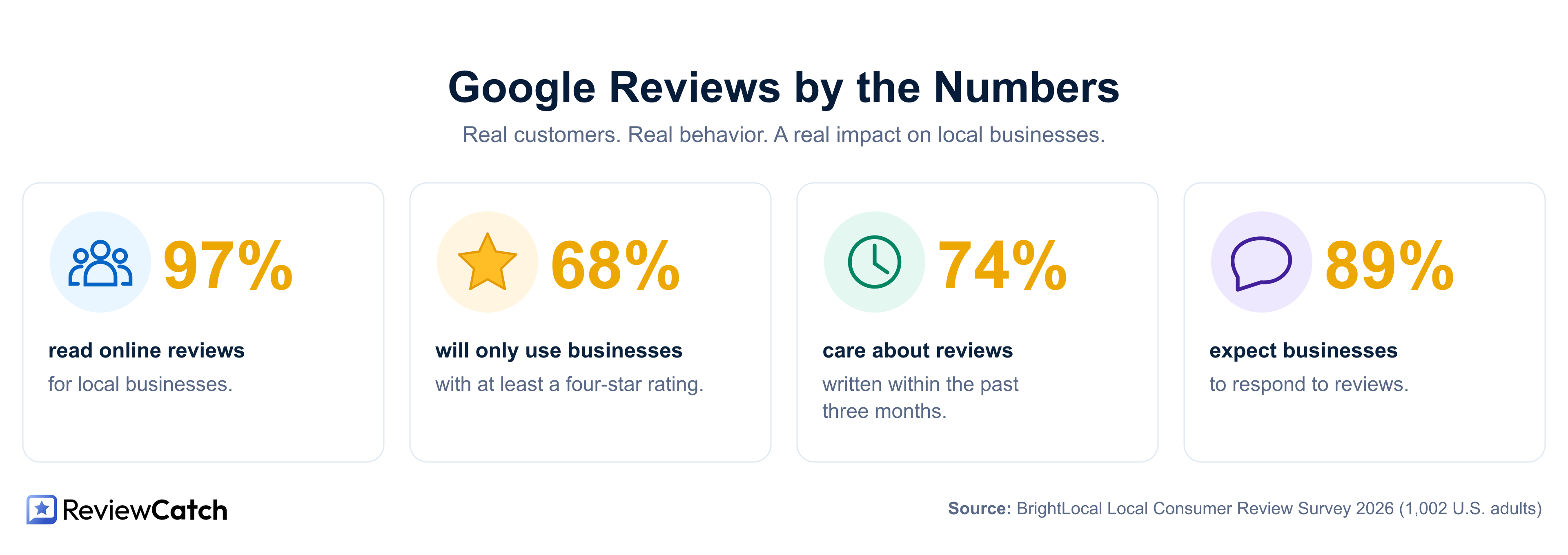
of consumers read online reviews for local businesses.
care about star ratings when choosing a business.
will only use businesses rated four stars or higher.
won't use a business with fewer than 20 reviews.
care about reviews written within the previous three months.
say positive reviews make them more likely to use a business.
expect businesses to respond to reviews.
are open to writing a business review.
Most of these figures come from BrightLocal's latest Local Consumer Review Survey, conducted with 1,002 U.S. adults.
Taken individually, those statistics are interesting.
Put together, they reveal something more useful: customers aren't judging businesses on one review metric. They're evaluating several signals at once.
The Review Trust Stack: Rating, Volume, Recency, and Response
A strong Google review profile isn't just about having five stars.
Customers are effectively evaluating four things:
- Rating: Are customers generally satisfied?
- Volume: Is there enough feedback for the rating to feel credible?
- Recency: Are people still having good experiences with the business today?
- Response: Does the business actually pay attention to its customers?
Think of these as a review trust stack.
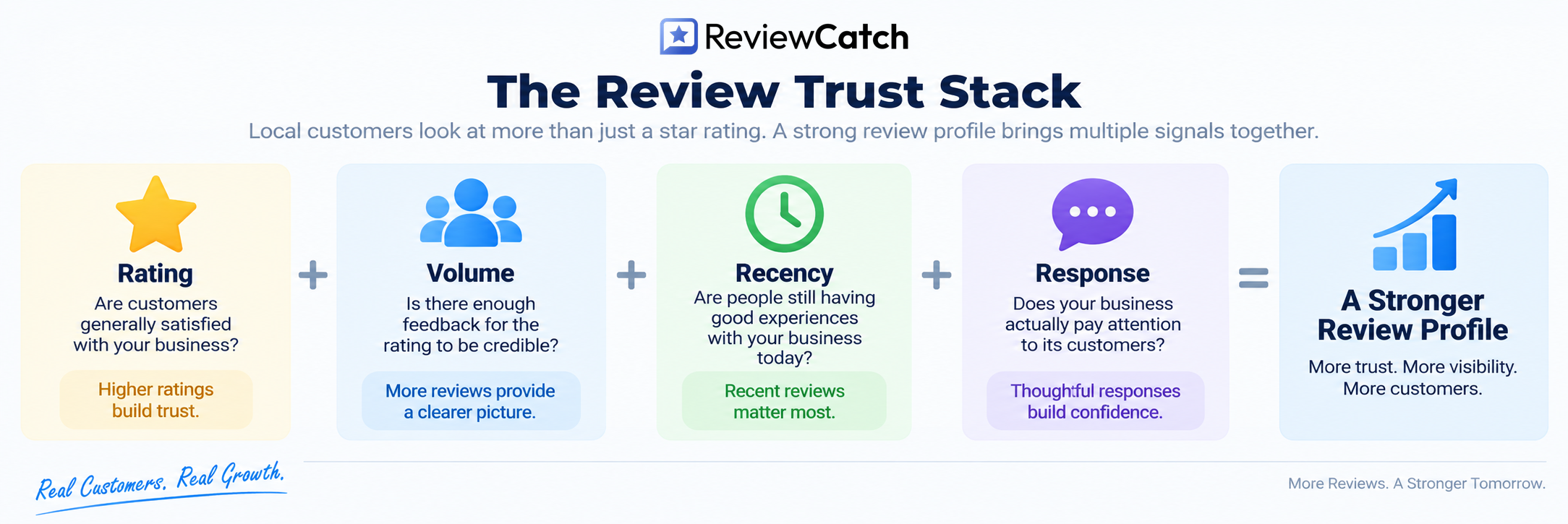
A weakness in one area can reduce the impact of the others.
A 5.0 rating from six customers doesn't carry the same weight as a strong rating backed by hundreds of experiences.
Five hundred reviews are less reassuring if the newest one is a year old.
And a profile full of unanswered customer complaints can undermine an otherwise impressive rating.
The strongest profiles tend to show multiple trust signals working together.
97% of Consumers Read Reviews for Local Businesses
BrightLocal found that 97% of consumers read online reviews for local businesses. Two in five say they read reviews every time they look for a business.
That changes what a first impression looks like.
Imagine someone searches for a service and sees:
Business A: 4.8 stars · 284 reviews
Business B: 4.5 stars · 103 reviews
Business C: 3.8 stars · 71 reviews
The customer already has information to work with before visiting a single website.
Business C might provide excellent service. It may have competitive pricing and a great team.
But the customer doesn't know that yet.
What they do know is what Google is showing them.
For local businesses, a Google Business Profile isn't simply a directory listing anymore. It's part of the customer acquisition process.
Google Remains a Major Source of Local Business Reviews
Consumers research businesses in more places than ever.
They use Google, Facebook, social media, traditional review websites, recommendations from friends, and increasingly AI tools.
BrightLocal found that 71% of consumers use Google when looking for local business reviews and recommendations.
And Google's review ecosystem operates at enormous scale.
Google reports that 1.14 billion local reviews were published on Google Maps and Search during 2025 alone. That figure is global.
The reason Google reviews are particularly important is their position in the buying journey.
Someone can search for a local service, compare businesses, read customer feedback, look at photos, check opening hours, visit a website, get directions, and call the business without leaving Google's ecosystem.
Reviews are appearing exactly when customers are deciding which businesses deserve further consideration.
68% of Consumers Require at Least Four Stars
Star ratings aren't everything, but they're difficult to ignore.
BrightLocal found that 92% of consumers care about star ratings when choosing a business.
Even more importantly, 68% will only use businesses rated four stars or higher, while 31% require at least a 4.5-star rating.
That creates a potential filtering effect.
A business can spend money on advertising, SEO, or other marketing to appear in front of a potential customer, only to be eliminated because the visible rating doesn't meet that person's threshold.
Getting discovered and getting chosen are two different problems.
Marketing can help with the first.
Reputation can heavily influence the second.
You Don't Need a Perfect 5.0 Rating
There is a useful flip side to the star-rating data.
Businesses sometimes treat anything below a perfect five stars as failure.
Customers aren't necessarily expecting perfection.
A business with a 4.7 or 4.8 rating supported by hundreds of recent, detailed customer experiences can still have an extremely strong reputation.
Google itself notes that honest and balanced feedback can help customers make decisions and that a mixture of positive and negative feedback can feel more trustworthy.
One less-than-perfect review isn't normally the problem.
A consistent pattern of unresolved complaints is.
Instead of chasing a flawless number, focus on whether the overall profile accurately reflects the experience your business provides.
Review Volume Adds Credibility
A high rating becomes more meaningful when enough customers are behind it.
BrightLocal found that 47% of consumers won't use a business with fewer than 20 reviews.
Compare:
5.0 stars from 4 customers
with:
4.8 stars from 237 customers
The first business has the mathematically higher rating.
The second gives a customer much more evidence to examine.
- They can look for recurring compliments.
- They can see whether complaints follow a pattern.
- They can compare older experiences with newer ones.
- They can see how the business behaves when something goes wrong.
That's why the first reviews a new business earns can be especially important. You're not simply increasing a counter beside your company name. You're building a body of customer evidence.
Recent Reviews Matter
Review volume isn't enough by itself.
BrightLocal found that 74% of consumers care about reviews written within the previous three months, and 44% consider whether a review was posted within the last month when evaluating it.
Consider two businesses with 200 reviews each.
One received 190 of those reviews several years ago.
The other continues receiving new customer feedback every month.
The total is almost identical.
The story isn't.
Recent reviews answer an important question:
What's this business like now?
Staff changes. Ownership changes. Processes improve. Customer service can get better or worse.
A review written last month often gives someone more useful information about their likely experience than a glowing review written five years ago.
This is why consistent review generation usually makes more sense than occasional review campaigns.
Positive Reviews Don't Always Make the Sale, But They Earn the Next Step
Reviews are often described as if someone reads five stars and immediately buys.
The actual customer journey is more complicated.
BrightLocal's research found that positive reviews make consumers more likely to use a business, but many continue researching afterward.
A typical journey might look like this:
That's an important distinction.
The job of your reviews isn't necessarily to complete the sale.
Often, it's to convince the customer that your business is worth investigating further.
Then the rest of your marketing has to do its job.
Great reviews can't compensate for a broken website. They can't fix incorrect business information. They can't answer a phone nobody picks up. And they can't rescue a poor customer experience.
Reviews can help get someone through the door. The business still has to deliver.
Google Says Reviews Can Help Local Search Rankings
There's another reason reviews matter: local SEO.
Google says local search results are mainly determined by relevance, distance, and prominence.
When explaining prominence, Google specifically states that more reviews and positive ratings can help a business's local ranking.
That does not mean there is a formula such as:
100 reviews = position #1 on Google Maps
There isn't.
Google considers numerous factors, and distance alone means two people searching for the same service can see different local results.
But Google's own documentation confirms that review quantity and ratings can contribute to local visibility.
Reviews therefore have the potential to work on two levels:
- Search visibility: Helping strengthen signals associated with your local presence.
- Customer conversion: Helping convince someone who sees your listing that your business deserves consideration.
Few reputation assets sit so close to both discovery and decision-making.
89% of Consumers Expect Businesses to Respond to Reviews
Getting reviews is only half the equation. Customers also pay attention to what happens afterward.
BrightLocal found that 89% of consumers expect businesses to respond to reviews.
Google encourages businesses to respond as well, noting that replies show customers their feedback matters.
Responses become particularly valuable when something goes wrong. A customer may leave a negative review because of a genuine mistake. There may have been a misunderstanding. Sometimes a complaint may seem unreasonable.
Whatever the situation, future customers can see both sides.
That's why a review response isn't only a message to the person who wrote the complaint. It's also a message to everyone who reads that complaint later.
A calm, professional response can demonstrate accountability in a way another five-star rating cannot.
Generic Responses Don't Build Much Trust
There is a difference between responding and simply checking a box.
Imagine scrolling through a business's reviews and seeing this under every one:
"Thanks for your feedback. We appreciate your business!"
Again. And again. And again.
Customers notice. BrightLocal's research found that consumers increasingly view generic responses negatively.
Google's own guidance also recommends keeping replies useful and relevant rather than sending everyone the same thank-you message.
You don't need to write an essay. One specific detail can make the response feel genuine.
Instead of:
Thank you for your review!
Try:
Thanks, Mark. We're glad the installation went smoothly and that the team finished ahead of schedule. We appreciate you choosing us.
The difference is small. The second response proves somebody actually read what the customer wrote.
94% of Consumers Are Open to Leaving Reviews
Businesses with weak review profiles sometimes assume their customers simply don't write reviews.
That may not be the real problem.
BrightLocal found that 94% of consumers are open to writing business reviews.
The bigger obstacle is often friction.
A customer might finish a transaction extremely satisfied. Then life continues. They pick up their kids. They make dinner. They answer messages. They think about tomorrow. Leaving your business a Google review disappears from their mind.
That's why simply hoping happy customers remember isn't much of a strategy.
Google explicitly allows businesses to remind customers to leave genuine reviews and provides review links and QR codes to make the process easier.
The easier the process is, the less you're depending on memory.
Businesses With More Reviews Aren't Necessarily More Loved
Imagine two businesses providing equally good customer experiences.
Business A has a process: After completing a job, the customer receives a polite message with a direct link to leave feedback.
Business B doesn't: Every once in a while, an employee remembers to say:
"If you get a chance, leave us a Google review."
Six months later, Business A may have considerably more customer feedback.
That doesn't automatically mean its customers are happier. It may simply mean the company created a better process for capturing the satisfaction it was already producing.
This distinction matters.
Review generation shouldn't be about manufacturing a reputation. It should be about making it easier for genuine customer experiences to become visible.
That's the problem ReviewCatch is designed around.
What Local Businesses Get Wrong About Google Reviews
Most businesses don't need complicated reputation strategies. They need to stop making simple mistakes:
- They wait until they desperately need more reviews before asking for them.
- They ask inconsistently.
- They make customers search for the review page themselves.
- They collect reviews for a few months and then stop.
- They ignore customer feedback after receiving it.
- They respond to everyone with the same canned message.
- Or they become obsessed with achieving a perfect five-star rating instead of looking at the health of the entire review profile.
There are also shortcuts businesses should avoid entirely. Google prohibits offering incentives in exchange for reviews, changes to reviews, or removal of negative feedback. Reviews are supposed to reflect genuine experiences.
A credible reputation is more valuable than an artificially perfect one.
A Simple Google Review Strategy
You don't need a 30-page reputation management plan. Start with five principles:
- Ask real customers for honest feedback. Don't dictate what they should say or what rating they should give.
- Reduce friction. Send customers directly to the place where they can leave feedback instead of making them search for it.
- Ask consistently. A steady flow of reviews is more useful than occasional bursts.
- Respond like a human. Keep responses short, relevant, and specific when appropriate.
- Learn from the feedback. If customers repeatedly complain about the same thing, the review problem may actually be an operational problem.
The goal isn't to reach one magic review number. There isn't one.
A business with 50 reviews might dominate one market and look invisible in another.
What matters is the strength of your review profile relative to your customers' expectations and the competitors appearing beside you.
Google Reviews Can Become a Long-Term Business Asset
Advertising stops running when you stop paying.
A genuine customer review can continue influencing potential customers long after it was written.
One review doesn't create much of an advantage. Dozens begin to establish a pattern. Hundreds of credible customer experiences accumulated over years create something much harder for a new competitor to replicate.
This is where the value compounds.
You're not simply trying to increase this month's review count. You're building a public history of how customers experience your business. Future customers can see it. Google can see it. And competitors can't reproduce it overnight.
Make Review Requests Part of the Customer Experience
Most satisfied customers don't need to be convinced to say something positive. They need to be asked at the right time and given an easy way to respond.
ReviewCatch helps local businesses automate review requests and follow-ups, so gathering customer feedback becomes part of the normal customer experience instead of something employees have to remember to do manually.
Build the process once. Keep collecting genuine customer feedback over time.
Research Note
Most consumer statistics in this article come from BrightLocal's 2026 Local Consumer Review Survey, based on a representative panel of 1,002 U.S. adults. The findings should therefore be interpreted as U.S. consumer survey data rather than universal statistics for every industry or country.
Google-specific information about review requests, responses, ratings, and local search rankings comes from Google's official Business Profile documentation and Transparency Report.