How Electricians Can Get More Google Reviews: A Step-by-Step Guide
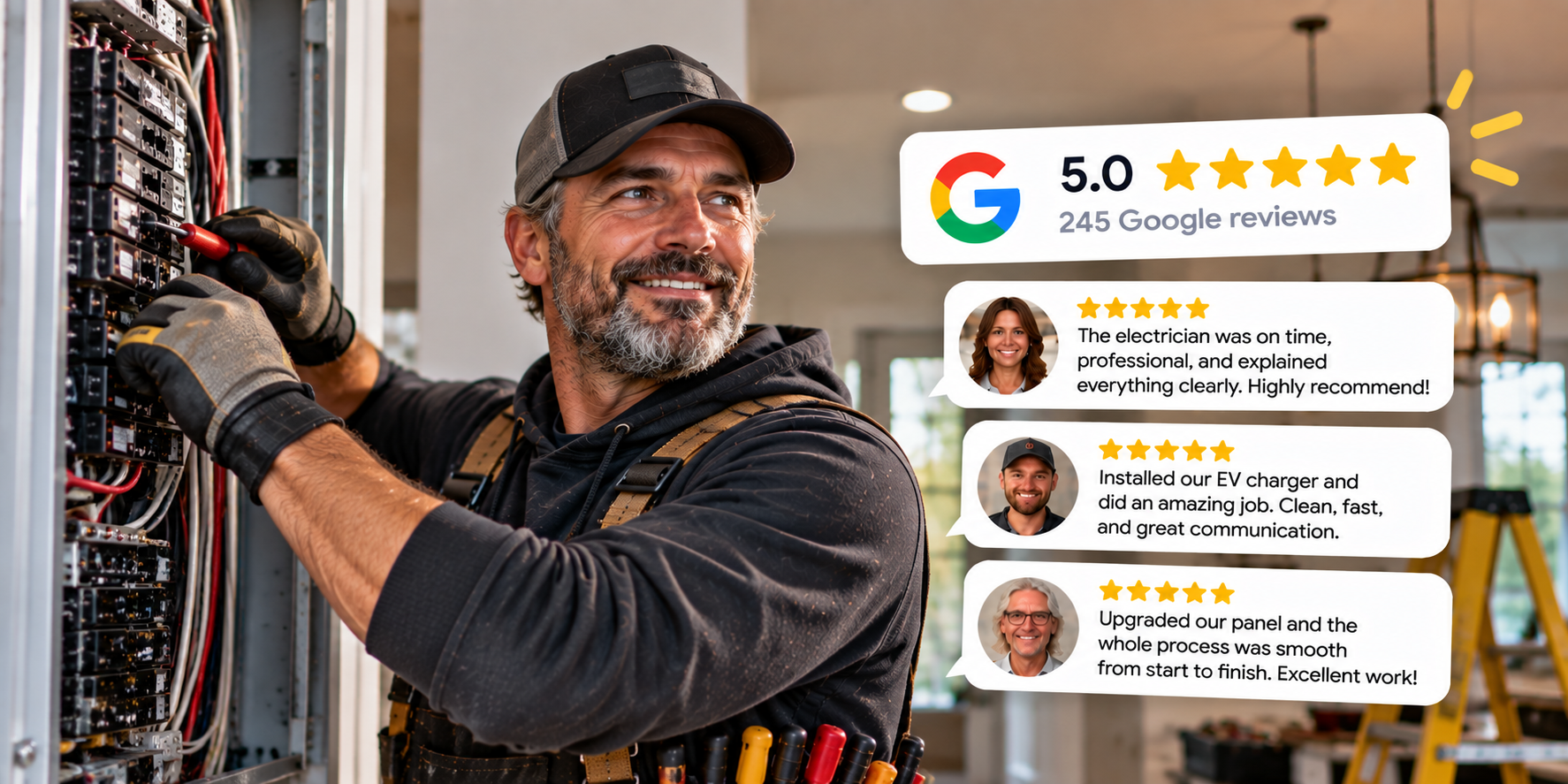
Electrical work has a trust problem before the electrician even arrives.
Most homeowners don't know enough about their electrical system to judge the technical side of the job. They have to trust that the electrician knows what they're doing, isn't recommending work they don't need, will respect the house, and won't leave behind a bigger problem.
That's one reason Google reviews carry so much weight for electrical contractors.
Someone searching for an electrician may be comparing several companies for a panel upgrade, EV charger installation, lighting job, generator, electrical repair, or a problem they can't even properly describe.
They'll often look at the review count and rating before they look at much else.
Google also says more reviews and positive ratings can help a business's local ranking, although reviews are only one part of how local results are determined.
The opportunity for electricians is straightforward: every completed job creates a natural chance to earn another genuine review.
The companies that build strong review profiles aren't necessarily asking harder. They're asking more consistently.
Here's how to do it.
Get Your Google Business Profile Right First
Before worrying about your next 100 reviews, look at the profile customers are actually reviewing.
Google says complete and accurate business information makes a company more likely to appear in relevant local searches. Its local results are mainly based on relevance, distance, and prominence.
For an electrical contractor, check:
Most electricians go to the customer's home or business rather than serving customers at a public storefront.
Google considers that a service-area business when the company visits customers directly but doesn't serve them at its own address. If customers don't actually visit your business address, Google says the public address should be removed and the service area used instead.
Keep that service area realistic.
Google currently allows up to 20 service areas and recommends that the overall boundary generally stay within about two hours of driving time from where the business is based.
Don't list every city you've ever heard of because you'd like a lead there.
List the places you actually send electricians.
Make Sure Your Electrical Services Are Listed
This is an easy thing to overlook.
Google lets eligible service businesses add their individual services to the Business Profile. When someone searches for a service you provide, that service may be highlighted on the profile.
Depending on your company, your services might include:
Don't treat the Services section like a place to stuff keywords.
List what you actually do.
There's another reason this matters. Google says customers reviewing certain service businesses may be asked what job the company performed. Those options can come from your Business Profile service list, website, common services for the business type, and other sources.
If EV charger installations have become a major part of your business but the service isn't listed anywhere, fix that.
A homeowner should be able to find your profile and quickly understand the type of electrical work you handle.
Ask After the Customer Knows the Job Is Finished
The best time to ask for a review depends on what you did.
Replacing an outlet is different from rewiring part of a house.
Installing an EV charger is different from troubleshooting a breaker that keeps tripping.
A useful rule:
Ask once the customer has seen the result and understands that the problem is solved.
Here's a practical starting point:
| Electrical job | Good time to ask |
|---|---|
| Small repair | Later the same day |
| Outlet or switch replacement | Later the same day |
| Lighting installation | After the customer sees everything working |
| Troubleshooting call | Once the problem is resolved |
| EV charger installation | After installation, testing, and walkthrough |
| Panel upgrade | After power is restored and work is explained |
| Generator installation | After testing and homeowner instruction |
| Renovation electrical work | After your portion of the project is complete |
| Rewiring project | After final testing and walkthrough |
| Emergency electrical call | Once the immediate problem is safely resolved |
You don't need to obsess over whether the message should go out 47 minutes or 90 minutes later.
The timing should make sense.
If the electrician is still testing circuits, don't ask.
If everything is done and the homeowner is happy, don't wait three weeks.
Build the Review Request Into Job Completion
This is where most electrical companies can make the biggest improvement.
Don't rely on someone remembering.
Your electrician already finishes the job somehow.
Maybe they:
- Complete the work.
- Test everything.
- Explain the repair.
- Take photos.
- Collect a signature.
- Close the work order.
- Trigger the invoice.
Attach the review request to one of those steps.
A simple workflow could look like:
If there's no response:
One reminder two or three days later
Then stop.
If you use field-service software, a CRM, or another job-management system, the review request should ideally be triggered by the completed job status.
The software isn't the important part.
Consistency is.
A company completing 200 electrical jobs every month has 200 potential opportunities to create a good customer experience. If the company only remembers to ask 15 of them for feedback, it's leaving most of those opportunities on the table.
Electricians Influence the Review Before They Ever Ask for It
A better review request won't fix a bad service experience.
Customers notice details that electricians sometimes take for granted.
Those things show up in reviews.
One of the biggest advantages an electrical company can create is having technicians who explain the work without drowning the customer in technical language.
The homeowner doesn't need a 20-minute lesson on electrical theory.
They want to know:
What was wrong?
What did you fix?
Is it safe now?
Is there anything else I need to know?
An electrician who can answer those four questions clearly is much easier to trust.
And trusted electricians tend to get better reviews.
Give Electricians One Simple Closing Line
Your electricians don't need to become salespeople for Google reviews.
Give them one sentence.
For example:
That's enough.
The review request that arrives later now has some context.
Avoid having electricians stand there while customers pull out their phones.
Avoid:
Avoid employee contests based entirely on who can collect the most reviews.
You're trying to create a normal follow-up process, not make the customer feel responsible for your Google rating.
Use Different Messages for Different Jobs
The message can still be automated without sounding like software wrote it.
General Electrical Service
Hi [First Name], thanks for choosing [Business Name] today. If you have a minute, we'd appreciate you sharing your experience on Google: [Review Link]
Electrical Repair
Thanks for having us out today, [First Name]. We're glad we could get everything sorted out. If you'd like to share your experience, here's our Google review link: [Review Link]
EV Charger Installation
Hi [First Name], thanks for trusting us with your EV charger installation. If you have a moment, we'd appreciate you sharing how everything went: [Review Link]
Panel Upgrade
Thanks again for choosing [Business Name] for your panel upgrade. If you'd like to share your experience with our team, you can leave a Google review here: [Review Link]
Lighting Project
Hi [First Name], we hope you're enjoying the new lighting. If you have a minute, we'd appreciate your feedback: [Review Link]
One Reminder
Hi [First Name], just following up in case you didn't get a chance earlier. If you'd like to share your experience, here's the link: [Review Link]
There's no need for a paragraph explaining how much reviews mean to your business.
Thank them. Ask. Give them the link.
Done.
Send Customers Directly to Google
If someone is willing to leave a review, make it easy.
Don't tell them:
Google provides businesses with a direct review link and QR code specifically for requesting customer reviews. Google suggests using the link in places such as receipts, thank-you emails, and customer communications.
Once you have your link, test it yourself.
Check that:
If your company operates multiple legitimate locations, make sure customers aren't being sent to the wrong profile.
One broken review link can quietly wreck an otherwise good process.
Emergency Electrical Calls Need Different Timing
Electrical problems can be stressful.
The homeowner may have:
- Lost power to part of the house
- Smelled something burning
- Found a hot outlet
- Had breakers repeatedly trip
- Discovered a potentially unsafe electrical issue
In that situation, the customer isn't thinking about helping your marketing.
Deal with the problem.
Make the situation safe.
Explain what happened.
Only ask for feedback once the immediate issue has been resolved.
A message later that day might say:
That feels reasonable.
Asking while the homeowner is still worried about whether the house is safe doesn't.
EV Charger Jobs Are Excellent Review Opportunities
EV charger installations deserve special attention because they're easy for the customer to understand.
Before the job, they don't have a working home charger.
Afterward, they do.
That's a clear result.
Finish the installation properly:
Then follow up.
These reviews can also be useful because future EV owners researching electricians may pay particular attention to customers who had the same type of installation.
You don't need to tell the customer:
Let them describe the experience naturally.
Bigger Projects Shouldn't Get the Same Treatment as Service Calls
Panel upgrades, rewiring, renovation work, and generator installations are larger jobs.
There's often more coordination involved.
There may be:
Don't automatically send the same review request the moment an electrician clocks out.
If something remains unresolved, wait.
For a panel upgrade, that may mean after the work is tested, power is restored, the homeowner understands what changed, and any necessary inspection steps are clear.
The review should come at the end of the experience, not halfway through it.
Don't Ask for Five Stars
Ask for feedback.
Google says reviews should reflect genuine customer experiences. It also prohibits offering free or discounted goods or services in exchange for someone posting, changing, or removing a review.
- Please leave us five stars.
- Help us maintain our 5.0 rating.
- Leave a positive review.
- Give us a review and get $25 off.
- Mention your electrician by name.
- Prewritten text the customer is supposed to copy
Your message can simply say:
That's enough.
A believable review profile is worth more than a suspiciously perfect one.
Don't Hammer Repeat Customers With Requests
Electricians can have plenty of repeat customers.
Someone might call you for a lighting job, then six months later for an EV charger, then later for work during a renovation.
You don't have to ask after every visit.
Keep customer history in mind.
A reasonable internal rule might be:
That doesn't mean you can never ask them again.
A major panel upgrade three years after a small repair is a completely different experience.
Use judgment.
Your automation should make the customer experience better, not make loyal customers feel like your database forgot who they are.
Read Reviews for Operational Problems
Don't just count reviews.
Read them.
Google says certain service businesses can receive feedback tied to specific aspects of the customer experience, and businesses can use that information to improve service.
Look for repeated comments about:
Suppose several customers say:
That's useful.
Your electrical work may be excellent.
Your dispatch communication isn't.
Or maybe customers constantly mention one electrician by name because they explain things clearly and leave the work area spotless.
Find out what that electrician is doing.
Reviews can show you both the weak spots and the employees who are quietly doing things right.
Respond Like a Real Person
Google says replying to reviews shows that you value customer feedback, and positive reviews along with helpful replies can help a business stand out.
Don't reply to every five-star review with:
It sounds automated because it usually is.
If someone writes:
Try:
Simple.
For negative reviews, don't fire off a response while you're angry.
Check:
- The work order
- Photos
- Technician notes
- Invoice
- Customer history
Talk to the electrician if necessary.
Then respond professionally.
The next customer reading the review is watching how your company handles problems.
Track the Numbers Once a Month
You don't need another complicated report.
Track:
Then calculate:
Example:
Your company completes 180 eligible residential jobs.
You send 160 review requests.
You receive 24 reviews.
That's a 15% response rate.
There isn't a magic percentage every electrician needs to hit.
You're establishing a baseline.
If your response rate suddenly drops from 15% to 5%, investigate.
Maybe:
- The link broke
- An automation stopped
- Requests are going out too late
- The message changed
- Customers don't recognize the sender
- Staff aren't closing jobs correctly
Without numbers, you'd probably just assume customers stopped leaving reviews.
Compare Yourself With the Electricians Customers Are Seeing
Search the terms your customers might actually use:
Look at the companies that consistently appear.
Compare:
- Review count
- Average rating
- Recent review activity
- Quality of reviews
- Whether they respond
Google confirms that review quantity and positive ratings can help local ranking, but rankings also depend on relevance, distance, and prominence.
So don't obsess over beating a competitor by one review.
If the established electricians in your area generally have 200 to 400 reviews and your company has 36, you've learned something useful.
There's a reputation gap.
Work on closing it steadily.
A 30-Day Review Plan for Electrical Contractors
If your current process is basically "ask when we remember," use the next month to fix it.
Clean Up Google
Check:
- Business information
- Categories
- Service areas
- Services
- Phone number
- Website
- Hours
- Photos
Get your direct review link and test it.
Define the Triggers
- Decide when requests go out after service calls, EV chargers, panel upgrades, larger projects, and emergency calls
- Decide which repeat customers should be excluded
Get the Team on the Same Page
- Give electricians one simple closing sentence
- Explain when the automated request goes out
- Make sure office staff knows the process
- Nobody should have to guess
Check What Happened
Count:
- Jobs completed
- Requests sent
- Reviews received
- Total reviews
- Average rating
Then actually read the reviews.
Look for patterns.
Don't change the entire system after one month unless something is clearly broken. Let consistency do some of the work.
The Review Request Is the Easy Part
Electrical companies sometimes spend too much time thinking about the exact wording of the text.
That's not where most reviews are won.
They're won when the electrician arrives on time.
When the customer gets a clear explanation.
When nobody tries to scare them into buying work they don't need.
When the job is neat.
When everything works.
When the electrician cleans up and leaves the house looking like they were never there.
The text message afterward is just the invitation.
Do good work.
Finish the job properly.
Make it easy for the customer to leave feedback.
Then repeat the process on the next call.
That's how an electrical company builds a strong Google reputation without having to constantly chase people for reviews.