How More Google Reviews Can Help You Get More Customers
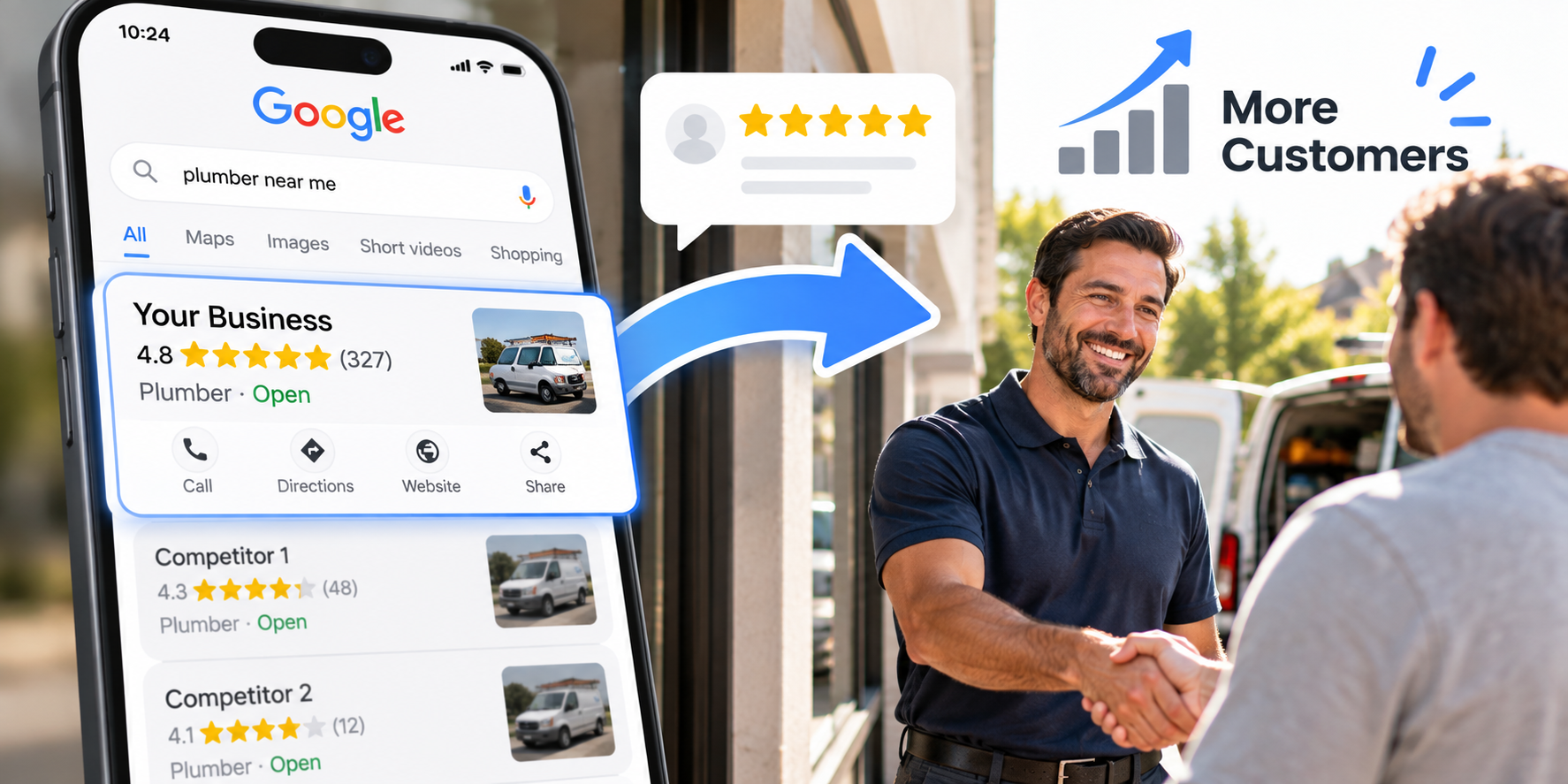
Getting more Google reviews sounds good in theory. But business owners usually care about a more practical question: Will more reviews actually bring me more customers?
They can. Not because every new five-star review automatically turns into a sale, and not because Google reviews are some kind of shortcut to the top of search results.
Reviews help because they influence several parts of the customer journey at the same time. They can make your business easier to notice, make people more comfortable choosing you, and give potential customers evidence that other people have already had a good experience.
For a local business, that can make a real difference. Here's how the connection works.
Reviews Help Customers Decide Whether You're Worth Considering
Picture someone searching Google for a contractor, mechanic, cleaning company, landscaper, or other local service. They may see several businesses at once:
Business A
237 reviews
Business B
18 reviews
Business C
61 reviews
Before the customer reads a website or calls anyone, they've already been given information that can affect which businesses they investigate further. That's one of the biggest jobs reviews perform: they help customers narrow down their options.
BrightLocal's 2026 consumer survey found that 97% of consumers read reviews for local businesses, while 85% said positive reviews make them more likely to use a business.
That doesn't mean the business with the most reviews always wins. Price, location, availability, services, recommendations, and other factors still matter. But a strong review profile can help you survive that first round of comparison.
Action Plan
- • Search Google for three services that are important to your business.
- • Look at the businesses customers are likely to compare with you and record their star rating, review volume, recency, and response habits.
- • Compare those numbers with your own.
- • This gives you a much more useful benchmark than simply deciding that you "need more reviews."
More Reviews Can Reduce the Risk of Choosing You
Hiring a business involves uncertainty. Will they show up? Will they do good work? Will they answer the phone if something goes wrong? Will the final bill match the quote? Customers don't know the answers when they've never dealt with you before. Reviews help fill that information gap.
A potential customer can read about experiences from people who have already taken the risk. They might see comments about:
- Reliability
- Communication
- Quality of work
- Pricing
- Professionalism
- Speed
- Customer service
- Problem handling
The effect becomes particularly important for expensive services. BrightLocal's 2026 survey found that among respondents, 27% reported spending more than $1,000 after reading reviews. The larger the purchase, the more reassurance a customer may want before committing.
Action Plan
- • Read your most recent 20 reviews — don't just count the stars.
- • Write down the specific reasons customers say they liked working with you.
- • If customers repeatedly praise punctuality, communication, or clean workmanship, those reviews are answering questions future prospects already have.
Reviews Can Help Your Business Appear in Local Search
There's another way reviews can contribute to getting customers: visibility. Google says local search results are mainly determined by relevance, distance, and prominence. Under prominence, Google specifically states that the number of reviews and positive ratings can help a business's local ranking.
That means reviews aren't only something people look at after finding you. They can also be one of the factors involved in whether people find you in the first place.
There are important limits to this. Getting another 30 reviews doesn't guarantee that you'll move three positions higher in Google Maps. Google considers other information as well, and distance can have a major effect. Someone searching two streets away may see different local results from someone searching across town. Reviews are one part of the picture.
Action Plan
Don't treat reviews as a replacement for basic Google Business Profile work. Make sure your profile also has:
- • The correct primary category and relevant secondary categories
- • Accurate hours and phone number
- • A direct link to your website
- • Complete service information
- • High-quality, real photos of your team and work
Review Volume Makes Your Reputation Easier to Judge
A five-star rating sounds great. But five stars from three customers doesn't tell you as much as a similar rating based on 200 customer experiences. Customers understand this instinctively. More genuine reviews provide a larger body of evidence.
They also give people more opportunities to find experiences that resemble their own situation. Someone hiring a contractor for a basement renovation may pay much more attention to a review mentioning a basement project than to a generic comment saying "Great company!" Someone looking for emergency plumbing may notice a customer describing how quickly a plumber arrived.
For eligible service businesses, Google can even ask reviewers about specific aspects of their experience or which job was performed, and that information may appear with the review. More reviews can therefore create a broader picture of what your business actually does.
Action Plan
- • Compare your review count with businesses competing for the same customers.
- • If you have substantially fewer reviews, don't try to close the gap overnight.
- • Set a manageable monthly target (e.g. current: 74 → goal in six months: 134 → monthly target: 10 new reviews).
- • A steady process is easier to maintain than a one-time push.
Recent Reviews Show That People Are Still Choosing You
Review count alone doesn't tell the whole story. Imagine a business has 450 reviews, but almost all of them are several years old. A customer might wonder: Is this business still as good as it used to be?
Recent reviews provide current evidence. They show that the business is still operating, still serving customers, and still generating experiences people think are worth talking about.
BrightLocal's 2026 research found that consumers increasingly care about fresh reviews rather than relying only on older feedback. That's why building reviews consistently is generally more useful than collecting a large batch and then stopping.
Action Plan
- • Look at your last 90 days and count new reviews received.
- • Calculate your average per month.
- • If you have 300 lifetime reviews but received only two during the last three months, your priority may be consistency rather than total review count.
Good Reviews Often Send Customers to the Next Step
Reviews don't always cause someone to immediately purchase. Often, they convince the person to keep researching you. That's still valuable.
The Customer Journey
Google search → reviews → website → contact → customer
BrightLocal found that after reading positive reviews, 54% of consumers visit the business's website. Others continue reading reviews, check social media, contact the business, visit the location, or make an appointment.
The review may not close the sale. Its job may simply be getting someone comfortable enough to click your website instead of the competitor beside you. This is also why a strong review profile can't compensate for a terrible next step. If your website is confusing, your phone goes unanswered, or customers can't figure out how to request a quote, some of the trust created by your reviews gets wasted.
Action Plan
- • Search for your business on your phone and browse like a first-time visitor.
- • Can you quickly understand what the business does?
- • Is the phone number easy to find and click?
- • Does the website load fast on mobile?
- • Can someone request a quote or book easily?
Reviews Can Answer Sales Questions Before You Do
A good review can do part of your selling for you without sounding like advertising. There's a big difference between a company saying:
"We provide excellent customer service."
and a customer writing:
"They called before arriving, showed up when they said they would, explained the work, and left everything clean."
The second statement carries weight because it comes from someone who actually paid for the service. Over time, your reviews can answer common concerns before someone even contacts you. A prospect worried about communication may find five reviews mentioning communication. Someone concerned about reliability may see customers repeatedly saying your team arrived on time.
Action Plan
- • Identify the five questions prospects ask most often before buying.
- • Read through your reviews to see whether past customers naturally answer them.
- • You may discover your reviews already contain your strongest sales arguments.
Responding to Reviews Gives Customers More Information
Customers don't only read reviews. They may also read your responses. Google recommends responding to customer reviews and says positive reviews and helpful replies can help a business stand out.
Your responses are particularly important when someone leaves criticism. A future customer may be less concerned that one person complained and more interested in how the business handled it. Arguing, insulting the reviewer, or becoming defensive can create a worse impression than the original complaint. A calm response shows future customers how you deal with problems.
Action Plan
- For positive reviews: Thank the customer, keep it natural, and reference something specific when appropriate.
- For negative reviews: Read carefully, investigate what happened, stay professional, avoid public arguing, and offer a direct phone number or email to resolve it privately.
- • Write for the hundreds of future customers who may eventually read the exchange, not only the person who posted it.
Measure Whether Reviews Are Actually Helping
Don't assume your review strategy is working just because the number keeps going up. Track it once a month:
Look at the trend over several months. You're trying to determine whether stronger reviews are happening alongside stronger customer activity.
Monthly Scorecard Example
A few months of data will tell you much more than checking your review count every morning.
More Reviews Help, but Only When They're Real
The goal shouldn't be to collect the largest possible number beside your business name. The goal is to build a strong, current record of genuine customer experiences.
More reviews can help potential customers:
- Notice your business in search
- Trust your reputation
- Understand what it's like to work with you
- Compare you favorably with competitors
- Feel more comfortable visiting your website
- Contact you with greater confidence
They can also contribute to local search visibility because Google considers reviews and positive ratings as part of prominence.
Do good work. Make it easy for customers to find you. Ask genuine customers for feedback. Keep collecting it consistently. Respond when people take the time to leave it.
That's how a review count becomes more than a number. It becomes evidence that helps the next customer decide whether to give you a chance.