How Roofers Can Get More Google Reviews: A Step-by-Step Guide
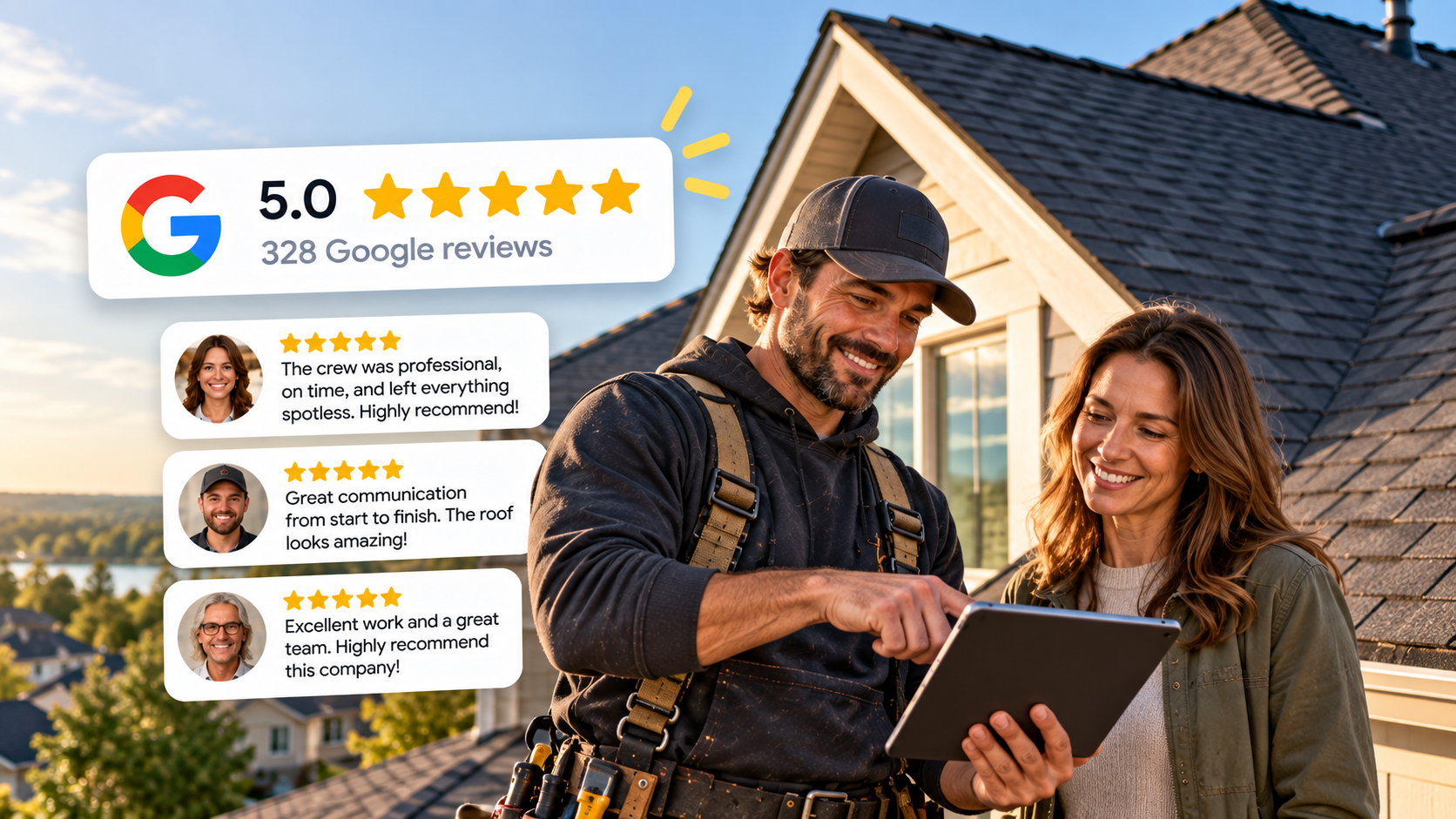
Roofing is one of those businesses where reputation matters before the homeowner ever picks up the phone.
A roof replacement can cost thousands of dollars. The crew may be working on the property for days. There’s noise, debris, ladders, dumpsters, materials, and a lot of trust involved.
Homeowners want to know they’re hiring a company that will show up, do the work properly, protect the property, clean up afterward, and answer the phone if something goes wrong.
That’s why they read reviews.
Google says reviews can help businesses stand out and give potential customers useful information. Google also confirms that more reviews and positive ratings can contribute to a business’s local ranking.
For roofing companies, there’s no shortage of opportunities to earn good reviews.
The challenge is asking at the right time and making review requests part of the job instead of something the office remembers once every few weeks.
Here’s how to build a review process that fits the way a roofing company actually operates.
Start With the Google Business Profile Homeowners Are Judging
Before trying to collect another 100 reviews, look at the profile they’re attached to.
Search your own company on Google from a homeowner’s point of view.
Does the profile immediately make sense?
Check:
Google says complete and detailed business information helps it understand what a business does and match the profile to relevant searches. Local rankings are mainly based on relevance, distance, and prominence. Reviews are one of the factors Google mentions when discussing prominence.
Most roofing companies travel to the customer rather than serving homeowners at a public storefront. If that describes your company, your Business Profile will usually operate as a service-area business.
Google says a service-area business visits customers directly but doesn’t serve them at its business address. If customers don’t actually come to your office, Google says the address should be removed from the public profile.
Keep your service area realistic too.
Google lets service-area businesses specify up to 20 service areas and recommends being accurate about where the business actually operates.
If your crews work within an hour of your office, don’t list cities three hours away just because you’d like leads from there.
Get the basics right first.
Make Sure Your Roofing Services Are Listed
A homeowner searching for a roof replacement may be looking for something very different from a homeowner dealing with a leak after a storm.
Your Business Profile should reflect the work you actually perform.
Depending on the company, that might include:
Google allows service businesses to add individual services to their Business Profiles. It may also use those services when customers search for something specific.
There's another reason this matters.
Google says customers reviewing certain service businesses may be asked which specific job the business performed. Those options can come from your service list, your website, common services for your industry, and other sources.
Take five minutes and compare the services on your Google profile with the jobs your crews completed over the last 30 days.
If you're doing a lot of roof replacements, repairs, or inspections that aren't represented, update the profile.
Don't stuff it with fifty variations of the same phrase. Just make it accurate.
Ask After the Homeowner Has Seen the Finished Job
Roofing companies need to be particularly careful with timing.
A roof isn't the same as a quick service call.
A homeowner may have spent weeks:
- Getting estimates
- Choosing materials
- Arranging financing
- Dealing with insurance
- Waiting for materials
- Watching the weather
- Living through the installation
Don't rush the review request.
For a full roof replacement, the best time is usually after the job is actually finished.
Proper Sequence:
Roof completed → property cleaned → debris removed → final inspection or walkthrough → homeowner satisfied → review request
Not:
Crew is still loading shingles into the truck → review request
For smaller jobs, you can usually ask sooner.
| Roofing job | Good time to ask |
|---|---|
| Small roof repair | Later the same day |
| Leak repair | After the homeowner knows the leak is resolved |
| Roof inspection | After findings have been explained |
| Full roof replacement | After cleanup and final walkthrough |
| Flat roof project | After completion and inspection |
| Emergency tarp or temporary repair | Usually after the permanent issue is addressed |
| Storm-damage project | After work is complete and major issues are resolved |
| Large multi-day project | After the customer has accepted the finished job |
You don't need to follow those timings down to the hour.
The point is to ask when the customer has enough information to judge the experience.
Cleanup Is Part of the Review Experience
Roofing companies sometimes think the review is mainly about the roof.
Homeowners often see it differently.
They notice the entire project.
That includes:
- Whether the crew arrived when expected
- Whether landscaping was protected
- Whether siding or windows were damaged
- Whether materials were left everywhere
- Whether nails were picked up
- Whether the dumpster disappeared on time
- Whether someone explained what was happening
- Whether the crew respected the property
A technically excellent roof can still produce an unhappy customer if the yard is full of debris when the crew leaves.
That's why the review process really starts long before the review request.
If you want homeowners to talk about professionalism, make the project feel professional.
Before anyone asks for feedback, somebody should inspect the property.
Walk around.
Check driveways.
Check garden beds.
Check the lawn.
Check for leftover material.
Use your magnetic sweeper.
Make sure the customer's property looks like a completed job, not an active construction site.
Then ask.
Make the Final Walkthrough Your Review Trigger
One of the cleanest ways to build reviews into a roofing workflow is to tie the request to the final walkthrough or project closeout.
Workflow:
Now nobody has to remember.
The completed status becomes the trigger.
If your roofing company uses a CRM, job-management platform, or automated follow-up system, this is where review requests should connect.
The exact software isn't the important part.
That keeps review collection running even during your busiest months.
Give Project Managers One Normal Sentence
Your project manager, salesperson, foreman, or whoever handles the homeowner relationship doesn't need a complicated review script.
At the end of the project, they might say:
That's enough.
The customer now knows the request is coming.
There's no need to stand in the driveway with a QR code waiting for them to leave five stars.
There's also no reason to tell employees:
That changes the conversation from customer service into pressure.
You want the project manager thinking about the job first:
- Was the homeowner kept informed?
- Were delays explained?
- Was the property protected?
- Was the work done properly?
- Was cleanup completed?
- Did we answer the customer's questions?
Good reviews are usually the result of those things.
Use a Direct Google Review Link
If someone is willing to review your roofing company, don't make them work for it.
Don't send:
Google provides businesses with a direct review link and QR code specifically for this purpose.
Google suggests using the link or QR code in places such as receipts, thank-you emails, and customer communications.
Before adding the link to your process:
- Open it yourself.
- Test it on a phone.
- Confirm it opens the correct Business Profile.
- Make sure it takes the customer where you expect.
If you have multiple roofing locations, be especially careful that each customer receives the correct link.
Use Messages That Sound Like Your Company
You don't need an elaborate review request.
You definitely don't need:
Nobody talks like that.
Keep it simple.
After a Roof Replacement
Hi [First Name], thanks again for trusting [Business Name] with your roof replacement. If you have a minute, we'd appreciate you sharing your experience on Google: [Review Link]
After a Roof Repair
Thanks for having us out today, [First Name]. If you'd like to share how everything went, here's our Google review link: [Review Link]
After a Leak Repair
Hi [First Name], we hope everything is looking good after the repair. If you have a moment, we'd appreciate your feedback: [Review Link]
After a Larger Project
Thanks again for choosing [Business Name] for your roofing project. If you'd like to share your experience with our team, you can leave a Google review here: [Review Link]
One Reminder
Hi [First Name], just following up in case you didn't get a chance earlier. If you'd like to share your experience, here's the link: [Review Link]
Then stop.
You don't need a seven-message review campaign.
Storm-Damage Customers Need Different Timing
Storm work is a little different.
The homeowner may be dealing with:
- Active leaks
- Damaged siding
- Insurance adjusters
- Temporary repairs
- Neighbours with similar damage
- Delays
- Material shortages
- A lot of stress
Don't pile a review request on top of that too early.
If you've only installed a temporary tarp, you're probably not at the end of the customer experience.
If the permanent repair hasn't happened yet, wait.
The best time is usually after your part of the job is genuinely complete and the homeowner understands what's been done.
If there's an unresolved issue between the homeowner, insurer, mortgage company, supplier, or your business, use some judgment before sending the request.
Automation is useful, but it shouldn't eliminate common sense.
Don't Ask Customers to Leave Five Stars
Ask for an honest review.
Google's guidance is clear that reviews should reflect genuine experiences. Google prohibits incentives such as free or discounted goods or services in exchange for reviews, changes to reviews, or removal of negative reviews.
Avoid messages like:
- “Please give us five stars.”
- “Help us keep our 5.0 rating.”
- “Leave a positive review.”
- “Give us a review and get $100 off.”
- “Only review us if you're happy.”
- “Please mention roof replacement and our city in your review.”
Don't write the review for the homeowner either.
You can ask them to share their experience.
They decide what to say.
That's what makes the review worth something to the next customer.
Use Before-and-After Photos Alongside Reviews
Roofing has a big visual advantage.
You can show the finished work.
Take good before-and-after photos whenever practical.
Photos can include:
Google encourages businesses to add photos and videos to Business Profiles because they help show customers what the business offers.
Your reviews tell one part of the story.
Your photos tell another.
A homeowner seeing:
alongside real project photos gets much more information than a profile showing three stock images and a logo.
Make project photography part of the completion checklist whenever the homeowner and circumstances allow it.
Don't Forget Roof Repairs
A roofing company may naturally focus on replacement customers because those jobs generate the most revenue.
But repair customers can be a major source of reviews.
Think about the homeowner who has water dripping through a ceiling during a storm.
Your company answers the phone.
Someone shows up.
The leak is located.
The repair gets done.
For the crew, it may be a relatively small invoice.
For the customer, you just solved the biggest problem they had that day.
That's a meaningful customer experience.
Small jobs can produce excellent reviews.
Don't create a review process that only triggers on large replacements.
Handle Repeat Customers Like Repeat Customers
Roofing doesn't have the same repeat frequency as HVAC maintenance or plumbing service, but repeat customers still happen.
A homeowner might:
- Hire you for a repair
- Call later for another section
- Eventually replace the whole roof
- Use you for another property
Don't blindly send the same review request after every interaction.
If someone already reviewed your company recently, you may not need another request for a minor follow-up.
On the other hand, a full roof replacement years after a small repair is a completely different experience.
Use customer history.
Your automation should help you communicate better, not make every customer feel like a new record in a database.
Read the Reviews as a Roofing Operations Report
Your reviews aren't only marketing.
They're feedback on how the company runs.
Google says some service businesses may have specific aspects of their customer experience rated, and it recommends using that information to improve service.
Read recent reviews and look for patterns around:
Suppose customers keep writing:
You probably don't have a roofing problem.
You have a communication problem.
If several customers praise one project manager for keeping them updated every day, figure out what that person is doing differently.
Reviews can expose operational problems and strong employees faster than a management meeting sometimes can.
Respond to Reviews Like a Person
Google recommends responding to reviews because it shows customers that their feedback matters. It also says positive reviews and helpful responses can help a business stand out.
You don't need this:
under every review.
If a customer says:
You can reply:
That sounds normal.
Negative reviews deserve more care.
Before responding:
- Check the job notes
- Talk to the salesperson or project manager
- Find out what happened
- Look at photos if relevant
- See whether the issue has already been resolved
Then reply calmly.
Don't have a public argument about who's right.
Future homeowners are reading your response too.
Track the Numbers Once a Month
You don't need another complicated dashboard.
Track:
• Eligible jobs completed
• Review requests sent
• New Google reviews
• Total reviews
• Average rating
• Reviews responded to
Then calculate:
Example:
Your company completes 60 eligible roofing jobs and repairs during the month.
You send 55 review requests.
You receive 11 reviews.
That's a 20% response rate.
The exact percentage isn't the important part.
You now have a baseline.
If that drops to 7% next month, you know something changed.
Maybe:
- Requests aren't being sent
- The link is broken
- Follow-ups stopped
- You're asking too late
- A new message sounds strange
- Customer experience declined
Without tracking, you're guessing.
Don't Obsess Over Beating a Competitor by One Review
It's worth knowing what other roofers in your market look like.
Search terms a homeowner would actually use:
Then look at companies that appear prominently.
Compare:
• Review totals
• Average rating
• Recent reviews
• Quality of reviews
• Whether the company responds
• Your own profile
Google says more reviews and positive ratings can help local ranking, but reviews aren't the entire ranking system. Relevance, distance, and prominence all play a role.
Don't think:
Think:
That's a useful conclusion.
A Simple 30-Day Roofing Review Plan
If you're currently asking for reviews whenever somebody remembers, fix the process over the next month.
Fix the Profile
Check your Google Business Profile.
Make sure your:
- Categories are correct
- Service area is accurate
- Roofing services are listed
- Hours are current
- Website works
- Phone number works
- Project photos are up to date
Get your direct review link and test it.
Define the Trigger
Decide when each type of customer gets asked.
Roof replacement: after final walkthrough
Repair: later that day
Storm job: after permanent work is complete
Inspection: after findings are delivered
Decide who should not receive a request yet.
Train the Team
Tell project managers and customer-facing employees what the process is.
Give them one sentence:
That's enough.
Make sure everyone understands that the goal is honest feedback, not forcing five-star reviews.
Look at the Results
Count:
- Jobs completed
- Requests sent
- Reviews received
- Current review total
- Average rating
Then read every new review.
Look for repeated comments about:
- Cleanup
- Communication
- Quality
- Crew behaviour
- Scheduling
Don't just celebrate the five stars.
Use the feedback.
The Best Review Strategy Starts Before You Ask
A roofing company can't text-message its way into a great reputation.
The review request is only the last few feet of the process.
The real work happened earlier.
It happened when your salesperson showed up.
When your office returned the phone call.
When the crew protected the homeowner's property.
When somebody explained the delay.
When the roof was installed.
When the last nail was picked up.
When the project manager answered the customer's final question.
If those things go well, asking for a review becomes easy.
Finish the job properly.
Walk the property.
Talk to the homeowner.
Send a simple review link.
Follow up once if necessary.
Then get back to work.
Do that consistently and the review count takes care of itself a lot more effectively than asking the office to “focus on reviews” every few months.